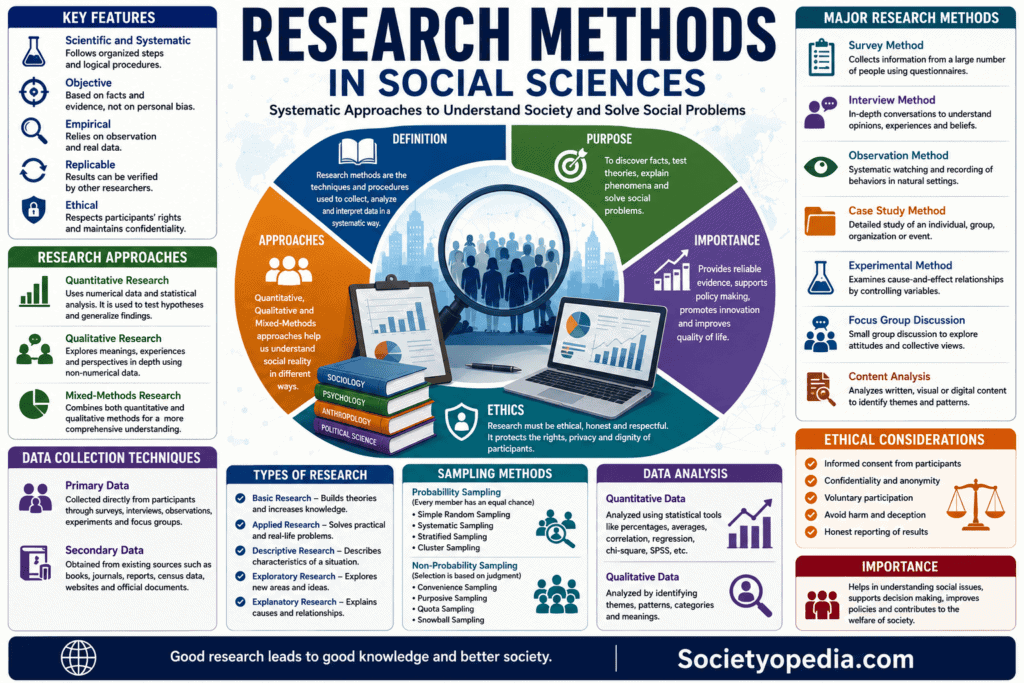
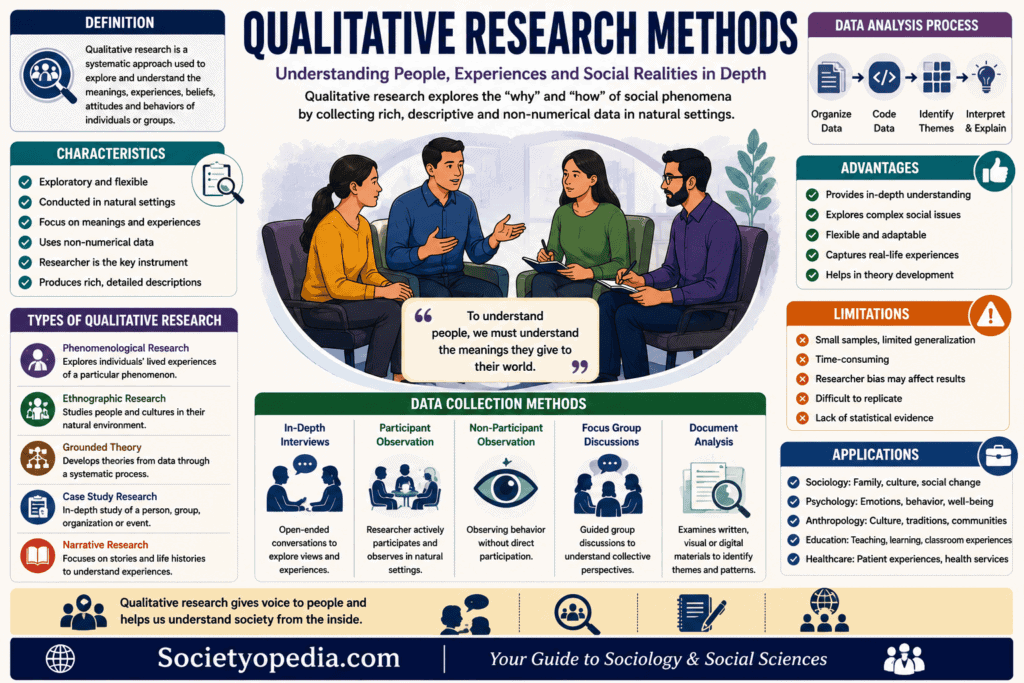
Probability sampling is one of the most reliable and scientifically accepted sampling techniques used in quantitative research. It is widely employed in sociology, psychology, education, economics, public health, political science, and business research because it ensures that every member of the target population has a known and non-zero chance of being selected. This method reduces selection bias and enables researchers to draw valid conclusions about an entire population based on the findings from a representative sample.
In research, it is often impossible to study every individual in a population because of limitations in time, cost, and resources. Sampling provides an efficient alternative by selecting a smaller group that accurately represents the larger population. However, the quality of research findings depends greatly on the sampling method. Probability sampling is considered the gold standard because it relies on random selection rather than the researcher’s personal judgment.
For example, if a sociologist wants to investigate public attitudes toward gender equality among university students in Pakistan, surveying every student in the country would be impractical. Instead, the researcher can use probability sampling to randomly select a representative sample of students, allowing the findings to reflect the views of the broader student population.
Because of its scientific rigor and ability to support statistical analysis, probability sampling is the preferred choice for large-scale surveys, national censuses, opinion polls, and academic research.

What Is Probability Sampling?
Probability sampling is a sampling technique in which every member of the target population has a known and measurable probability of being selected for the study. Participants are chosen through random selection methods rather than convenience or personal preference, ensuring fairness and reducing sampling bias.
The main objective of probability sampling is to obtain a representative sample that accurately reflects the characteristics of the entire population. Since each individual has an equal or predetermined chance of selection, researchers can use statistical methods to generalize the findings to the larger population with confidence.
For instance, if a university has 10,000 students and a researcher wishes to study student satisfaction, selecting participants randomly ensures that every student has a fair opportunity to be included in the study.
Definitions of Probability Sampling
Probability sampling has been defined by several renowned research scholars.
Earl Babbie defines probability sampling as a sampling method in which every element of the population has a known probability of selection.
William Lawrence Neuman explains that probability sampling uses random procedures to select participants so that every member of the population has a calculable chance of inclusion.
John W. Creswell describes probability sampling as a method that enables researchers to make statistical generalizations because the sample is selected randomly.
Ranjit Kumar defines probability sampling as a scientific sampling procedure in which each member of the population has an equal or known opportunity to be selected.
These definitions emphasize three important principles:
- Every population member has a known chance of selection.
- Participants are selected using random methods.
- The resulting sample is more likely to represent the entire population.
Characteristics of Probability Sampling
Probability sampling possesses several unique characteristics that distinguish it from non-probability sampling methods.
Random Selection
Participants are selected through random procedures such as lottery methods, random number tables, or computer-generated random numbers. Personal judgment is not involved in the selection process.
Equal or Known Probability
Every member of the population has either an equal or predetermined chance of being selected.
Representative Sample
Random selection increases the likelihood that the sample accurately represents the characteristics of the population.
Reduced Selection Bias
Because the researcher does not choose participants personally, the possibility of selection bias is significantly minimized.
Supports Statistical Analysis
Probability sampling allows researchers to estimate sampling error, calculate confidence intervals, and conduct hypothesis testing.
High External Validity
Research findings obtained through probability sampling can often be generalized to the entire target population.
Objectives of Probability Sampling
Probability sampling is used to achieve several important research objectives.
The primary objective is to obtain a representative sample that reflects the characteristics of the population.
It also aims to reduce bias during participant selection and improve the accuracy of research findings.
Another important objective is to enable researchers to apply statistical tests and make reliable generalizations about the larger population.
Probability sampling also ensures fairness by giving every eligible individual an equal opportunity to participate in the research.
Types of Probability Sampling
Probability sampling includes several techniques, each suitable for different research situations.
Simple Random Sampling
Simple random sampling is the most basic and widely used probability sampling technique. Every individual in the population has an equal chance of being selected.
Researchers usually assign numbers to all population members and use a lottery method or computer-generated random numbers to select participants.
Example
A university has 5,000 students. A researcher assigns each student a number and uses computer software to randomly select 500 students for a survey.
Advantages
- Easy to understand and implement.
- Minimizes researcher bias.
- Produces highly representative samples.
Limitations
- Requires a complete list of the population.
- Becomes difficult with very large populations.
Systematic Sampling
Systematic sampling involves selecting participants at regular intervals from an ordered list.
The researcher first calculates the sampling interval by dividing the population size by the required sample size. After randomly selecting the first participant, every nth individual is chosen.
Example
A company has 2,400 employees and requires a sample of 240. The sampling interval is 10, so every tenth employee is selected after a random starting point.
Advantages
- Simple and quick.
- Suitable for large populations.
- Less time-consuming than simple random sampling.
Limitations
- Hidden patterns in the list may introduce bias.
- Requires an ordered population list.
Stratified Random Sampling
Stratified random sampling divides the population into homogeneous groups called strata based on characteristics such as gender, age, education, or occupation.
Random samples are then selected from each stratum.
Example
A researcher studying university students divides the population into undergraduate and postgraduate students before randomly selecting participants from each category.
Advantages
- Improves representativeness.
- Ensures all important subgroups are included.
- Increases precision of estimates.
Limitations
- Requires detailed population information.
- More complex than simple random sampling.
Cluster Sampling
Cluster sampling divides the population into naturally occurring groups called clusters.
Instead of selecting individuals, the researcher randomly selects entire clusters.
Example
A researcher studying school students randomly selects ten schools and surveys all students within those schools.
Advantages
- Reduces travel costs.
- Suitable for geographically dispersed populations.
- Practical for large-scale surveys.
Limitations
- May produce less precise estimates.
- Clusters may differ significantly from one another.
Multistage Sampling
Multistage sampling combines two or more probability sampling techniques.
Researchers first select larger units and then progressively select smaller units.
Example
A national education survey may randomly select provinces, then districts, then schools, and finally students within selected schools.
Advantages
- Practical for nationwide research.
- Reduces costs and logistical challenges.
- Suitable for very large populations.
Limitations
- More complicated to design.
- Sampling errors may accumulate at different stages.
Steps in Conducting Probability Sampling
Conducting probability sampling requires careful planning.
Step 1: Define the Target Population
Identify the entire population to which the research findings will apply.
Step 2: Develop a Sampling Frame
Prepare a complete list of all population members.
Step 3: Determine the Sample Size
Calculate an appropriate sample size using statistical formulas or sample size calculators.
Step 4: Select a Probability Sampling Technique
Choose the most suitable method based on research objectives and population characteristics.
Step 5: Randomly Select Participants
Use an appropriate randomization procedure to select participants.
Step 6: Collect Data
Gather information using surveys, questionnaires, interviews, or observations.
Step 7: Analyze and Interpret Results
Use statistical methods to analyze the collected data and draw conclusions.
Advantages of Probability Sampling
Probability sampling offers several important benefits.
Produces Representative Samples
Random selection increases the likelihood that the sample accurately reflects the target population.
Reduces Sampling Bias
The use of random procedures minimizes researcher influence and personal bias.
Supports Statistical Inference
Researchers can estimate sampling error and confidently generalize findings.
Enhances Research Credibility
Scientific sampling methods improve the reliability and validity of research.
Suitable for Large Populations
Probability sampling is highly effective for national surveys and large-scale studies.
Encourages Objectivity
Selection depends on chance rather than subjective judgment.
Limitations of Probability Sampling
Although probability sampling is highly reliable, it also has certain limitations.
Requires a Complete Sampling Frame
Researchers often need a complete and accurate list of the population, which may not always be available.
Expensive
Large-scale probability sampling requires financial and human resources.
Time-Consuming
Preparing sampling frames and conducting random selection can take considerable time.
Complex Procedures
Some techniques, such as stratified and multistage sampling, require advanced planning and statistical expertise.
Difficult for Hidden Populations
Random sampling is challenging when studying populations that are difficult to identify or access.
Probability Sampling vs. Non-Probability Sampling
| Feature | Probability Sampling | Non-Probability Sampling |
|---|---|---|
| Selection Method | Random | Non-random |
| Chance of Selection | Known | Unknown |
| Research Bias | Low | Higher |
| Representativeness | High | Lower |
| Statistical Analysis | Possible | Limited |
| Generalization | Strong | Limited |
| Cost | Higher | Lower |
| Common Use | Quantitative Research | Qualitative Research |
Applications of Probability Sampling
Probability sampling is used across numerous disciplines.
In sociology, it is used to study social inequality, migration, family structures, crime, and public opinion.
In education, researchers investigate student achievement, teaching effectiveness, and educational policies.
In public health, it is used to estimate disease prevalence, vaccination coverage, and healthcare access.
In political science, probability sampling is widely used in election polls and public opinion surveys.
Businesses use probability sampling to understand consumer preferences, customer satisfaction, and market trends.
Challenges in Probability Sampling
Despite its advantages, researchers may face practical challenges while using probability sampling. Obtaining a complete sampling frame can be difficult, particularly in large or rapidly changing populations. Non-response from selected participants may reduce the representativeness of the sample, requiring follow-up efforts or statistical adjustments. Additionally, conducting random sampling across geographically dispersed populations often demands substantial financial resources, trained personnel, and careful logistical planning.
Best Practices for Using Probability Sampling
To obtain reliable results, researchers should ensure that the sampling frame is complete and up to date. The chosen sampling technique should match the nature of the population and the research objectives. Random selection procedures must be followed consistently without personal intervention. Researchers should also determine an adequate sample size before data collection and maintain detailed records of the sampling process to enhance transparency and reproducibility.
Conclusion
Probability sampling is one of the most reliable and scientifically accepted sampling techniques in quantitative research. By ensuring that every member of the population has a known chance of selection, it produces representative samples, minimizes bias, and strengthens the accuracy of research findings. Its ability to support statistical analysis and generalize results makes it indispensable in social sciences, education, healthcare, economics, and market research.
Although probability sampling requires careful planning, an accurate sampling frame, and sufficient resources, its benefits far outweigh its limitations. Researchers who apply probability sampling correctly can produce high-quality evidence that contributes to informed decision-making and advances scientific knowledge.
At Societyopedia, understanding probability sampling provides students and researchers with a strong methodological foundation for designing reliable studies and interpreting quantitative research with confidence.
Frequently Asked Questions (FAQs)
What is probability sampling?
Probability sampling is a sampling method in which every member of the population has a known and measurable chance of being selected through random procedures.
What are the main types of probability sampling?
The five major types are simple random sampling, systematic sampling, stratified random sampling, cluster sampling, and multistage sampling.
Why is probability sampling important?
It reduces sampling bias, improves representativeness, supports statistical analysis, and allows researchers to generalize findings to the target population.
What is the difference between probability and non-probability sampling?
Probability sampling uses random selection with known selection probabilities, while non-probability sampling relies on non-random methods where selection probabilities are unknown.
Which research approach commonly uses probability sampling?
Probability sampling is primarily used in quantitative research because it supports statistical analysis and population-level generalization.