Introduction
Culture and society are two fundamental concepts in sociology that are closely connected with human life. Human beings are social beings who live together in groups, and their way of living is shaped by the culture they create and share. Society refers to the organized system of human relationships, while culture refers to the beliefs, values, traditions, behaviors, and material objects that people create and use as members of society.
No society can exist without culture, and culture cannot exist without society. Society provides the structure where people interact, while culture provides the meaning, rules, and patterns that guide those interactions. Sociologists study culture and society to understand human behavior, social relationships, and the development of communities.
Definition of Society
Different sociologists have defined society from different perspectives.
According to MacIver and Page, “Society is a web of social relationships which is always changing.” This definition emphasizes that society is based on interactions and relationships among people.
According to Anthony Giddens, society refers to a group of people who live together in a particular territory and share common institutions, relationships, and cultural patterns.
Émile Durkheim viewed society as a system of social facts that influence individuals and create social order.
In simple words, society is a group of people who interact with each other, share common institutions, and live according to certain social rules and patterns.
Definition of Culture
Culture is one of the most important concepts in sociology. It includes everything that people learn and share as members of a society, including beliefs, values, language, customs, traditions, knowledge, and behaviors.
According to Edward Burnett Tylor, “Culture is that complex whole which includes knowledge, belief, art, morals, law, custom, and any other capabilities and habits acquired by humans as members of society.”
According to Ralph Linton, culture is the way of life shared by members of a society.
Clifford Geertz explained culture as a system of meanings through which people understand and interpret their social world.
In simple words, culture is the learned way of life that guides people’s thinking, behavior, and interaction.
Relationship Between Culture and Society
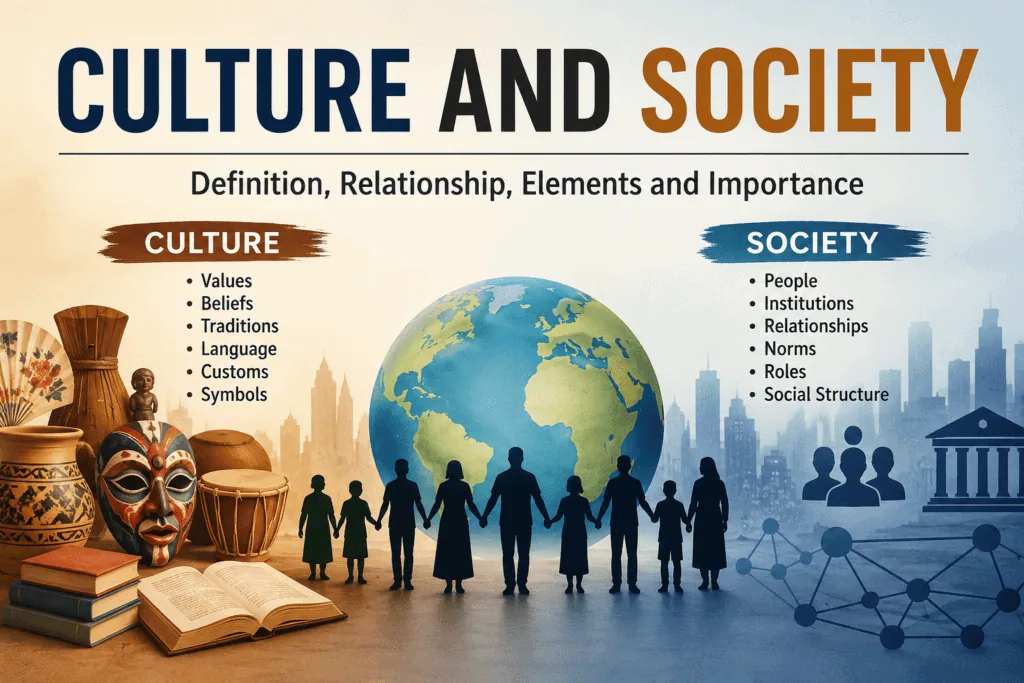
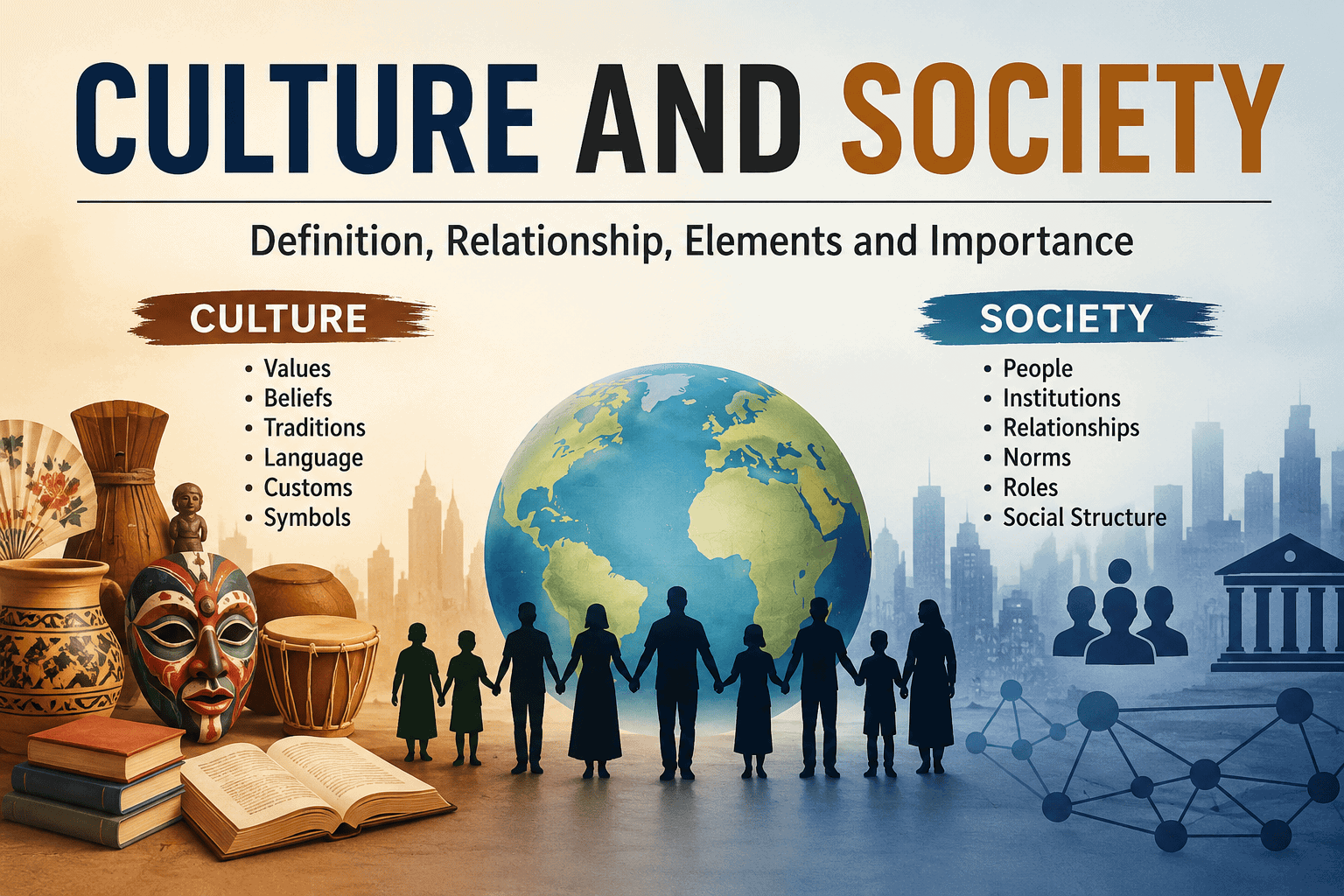
Culture and society are deeply interconnected. Society is the group of people who live together, while culture is the way of life shared by those people.
Society creates culture through human interaction, and culture influences how society functions. For example, family relationships, religious practices, language, and social traditions are cultural patterns that exist within society.
Culture provides rules and meanings for social behavior. It tells individuals how to communicate, how to behave in different situations, and what values are important. Society provides the social environment where these cultural patterns are practiced.
Without society, culture cannot be created or transmitted. Similarly, without culture, society would lack organization and shared understanding.
Characteristics of Culture
Culture is learned rather than inherited biologically. Individuals learn culture through the process of socialization from family, education, religion, and other social institutions.
Culture is shared because members of a society collectively follow certain values, beliefs, and practices. A culture becomes meaningful when it is shared among people.
Culture is transmitted from one generation to another. Parents, schools, and social institutions transfer cultural knowledge and traditions to younger generations.
Culture is dynamic and changes over time. New technologies, globalization, migration, and social changes influence cultural development.
Culture is integrated because different parts of culture are connected with each other. Changes in one area of culture often affect other areas.
Elements of Culture
Language
Language is one of the most important elements of culture. It allows people to communicate ideas, express feelings, and transfer knowledge. Language also carries cultural identity and traditions.
Values
Values are shared ideas about what is considered good, important, or desirable in society. They influence people’s decisions and behaviors.
Norms
Norms are social rules and expectations that guide behavior. They define what behaviors are acceptable or unacceptable within a society.
Beliefs
Beliefs are ideas and understandings that people consider true. Religious beliefs, moral beliefs, and social beliefs influence human actions.
Customs and Traditions
Customs and traditions are established ways of behaving that are passed from one generation to another. They reflect the history and identity of a society.
Material Culture
Material culture includes physical objects created and used by people, such as clothing, technology, buildings, tools, and art.
Non-Material Culture
Non-material culture includes ideas, values, beliefs, language, and social norms that cannot be physically touched but influence human behavior.
Characteristics of Society
- Society is based on social interaction. People must communicate and interact with each other for society to exist.
- Society has social institutions such as family, education, religion, economy, and government that organize social life.
- Society has common goals and shared expectations that create cooperation among individuals.
- Society is constantly changing because human relationships and social conditions continue to develop.
- Society has social structures that define relationships between individuals and groups.
Types of Culture
Material culture refers to physical things created by humans, such as technology, buildings, and objects used in daily life.
Non-material culture includes ideas, beliefs, values, traditions, and norms.
Popular culture includes widely accepted cultural practices, entertainment, fashion, and media trends.
Folk culture refers to traditional practices and customs usually associated with local communities.
Importance of Culture in Society
Culture provides individuals with identity and a sense of belonging. It helps people understand who they are and where they come from.
Culture maintains social order by providing rules and expectations for behavior. People learn how to behave appropriately through cultural values and norms.
Culture promotes social unity because shared traditions and beliefs create connections among people.
Culture also helps individuals adapt to their environment by providing knowledge and practices needed for survival.
Importance of Society in Human Life
Society provides individuals with security, cooperation, and opportunities for development. Humans depend on society for education, employment, relationships, and protection.
Society helps individuals develop their personality and social identity through interaction with others.
Through society, people organize their activities and create systems that improve their quality of life.
Culture, Society and Social Change
Culture and society are constantly changing due to factors such as technology, globalization, economic development, and social movements.
Changes in society influence culture, and cultural changes also transform society. For example, digital technology has changed communication patterns, family relationships, education, and work styles.
Sociologists study these changes to understand how societies develop and respond to new challenges.
Conclusion
Culture and society are essential concepts for understanding human life. Society provides the structure of social relationships, while culture provides the meanings, values, and behaviors that guide those relationships.
Culture shapes human identity, influences behavior, and connects generations through shared traditions and beliefs. Society organizes human interaction and creates institutions that maintain social life. Together, culture and society form the foundation of human civilization and help explain the complexity of social behavior.