Introduction
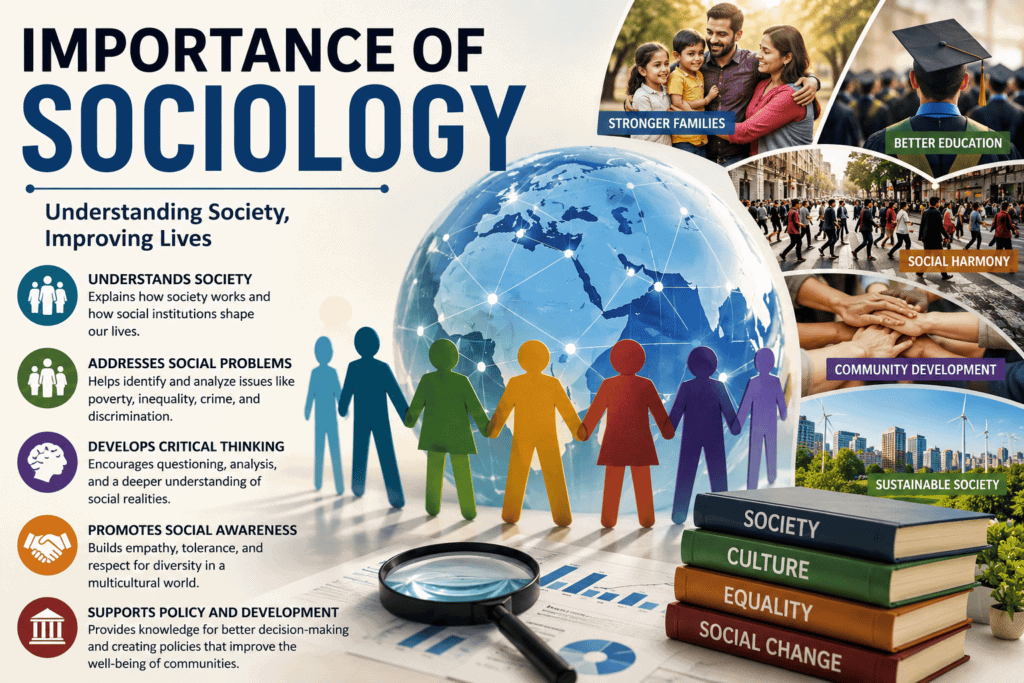
Sociology, as the scientific study of human society and social relationships, occupies a position of singular importance in the intellectual and practical life of the modern world. It is a discipline that illuminates the hidden structures and forces that shape individual lives, collective behavior, and the organization of social institutions. The importance of sociology is not merely academic; it is deeply practical and profoundly human. In an era characterized by rapid social transformation, deepening inequality, global interconnection, and urgent social crises, the knowledge and perspectives that sociology provides are indispensable for citizens, policy makers, educators, social workers, business leaders, and all those who seek to understand and improve the world they inhabit.
The significance of sociology can be understood across multiple dimensions: its role in fostering critical self-understanding and social awareness among individuals; its contribution to the formulation and evaluation of social policy; its role in promoting cultural tolerance and social cohesion in diverse societies; its contribution to democratic citizenship and civic engagement; its relevance to the professional world; and its broader intellectual contribution to the human quest for understanding. Each of these dimensions reflects a different facet of sociology’s importance, and together they constitute a compelling case for the central place of sociology in both academic life and the broader culture.
1. Importance of Sociology for the Individual
One of the most fundamental contributions of sociology is to the self-understanding of individuals. Human beings are profoundly social creatures whose identities, values, beliefs, aspirations, and opportunities are shaped in powerful ways by the societies and social groups to which they belong. Yet, in the course of ordinary life, most people experience their social world as simply given — as the natural order of things — rather than as a historical and social construction that might have been, and might yet be, otherwise. Sociology performs the vital intellectual service of making the familiar strange: of revealing the social forces, historical processes, and power relations that underlie the seemingly natural features of social life.
The American sociologist C. Wright Mills captured this contribution in his famous concept of the sociological imagination. For Mills, the sociological imagination is the capacity to see the connection between one’s own personal biography and the broader historical and social forces that shape it. A person who loses their job during an economic recession, for example, may blame themselves for their misfortune. The sociological imagination enables them to see that their experience is not merely a personal failure but a reflection of structural economic forces that affect millions of people simultaneously. This insight does not remove individual responsibility but enriches it, by situating individual lives within a broader social context and revealing the structural constraints and enablements that shape individual choices and outcomes.
The sociological imagination thus fosters a form of critical self-awareness that is both intellectually emancipating and practically empowering. It enables individuals to question taken-for-granted assumptions about social life, to recognize the social construction of their own identities and values, and to see themselves as actors with the capacity to understand and, potentially, to reshape their social world. In a world saturated with ideological messages that naturalize existing arrangements of power and inequality, this critical awareness is an essential tool for intellectual and personal freedom.
2. Importance of Sociology for Social Policy
Perhaps the most immediately practical dimension of sociology’s importance lies in its contribution to the formulation, implementation, and evaluation of social policy. Governments, international organizations, non-governmental organizations, and community groups regularly rely on sociological research to understand the nature and causes of social problems, to design effective interventions, and to assess the outcomes of policy initiatives. Without sociological knowledge, policy making is reduced to guesswork, ideology, or the projection of common sense assumptions that may bear little relation to social reality.
Understanding Poverty and Inequality
Sociological research has been central to the understanding of poverty and economic inequality. Sociologists have demonstrated that poverty is not simply the result of individual failure or lack of effort but is deeply rooted in structural features of the economic system, including the distribution of opportunities, the functioning of labor markets, the provision of education and healthcare, and the role of discrimination based on race, gender, and class. This structural understanding of poverty has been essential to the design of effective anti-poverty policies, from social welfare programs and minimum wage legislation to investment in early childhood education and community development.
The sociological study of inequality has also revealed the complex ways in which different dimensions of social disadvantage — class, race, gender, disability, age, and sexuality — intersect and compound one another to produce patterns of cumulative disadvantage. This insight, captured in the concept of intersectionality developed by the legal scholar and sociologist Kimberlé Crenshaw, has been enormously influential in shaping more nuanced and effective social policies that address the specific needs and circumstances of multiply disadvantaged groups.
Education Policy
Sociology has made fundamental contributions to the understanding of education and to the design of educational policy. Sociologists have demonstrated that educational achievement is shaped not only by individual ability and effort but by a wide range of social factors, including family background, socioeconomic status, the organization of schools, teacher expectations, peer influences, and the cultural values that are embedded in the curriculum. This sociological understanding has been essential to policy debates about school funding, curriculum design, affirmative action, and the role of standardized testing in shaping educational opportunity.
The sociological concept of cultural capital, developed by the French sociologist Pierre Bourdieu, has been particularly influential in education policy. Bourdieu argued that middle- and upper-class families transmit to their children not only economic resources but also cultural knowledge, dispositions, and ways of engaging with the world that are recognized and rewarded by educational institutions. This concept has helped policy makers understand why educational inequality persists even when formal barriers to access have been removed, and has informed policies aimed at providing disadvantaged students with the cultural as well as the material resources they need to succeed.
Healthcare and Public Health
Sociology has also made vital contributions to the understanding of health and illness and to the design of effective public health policy. The social determinants of health — the social, economic, and environmental conditions that shape patterns of disease and well-being — have been a central concern of medical sociology for decades. Sociologists have demonstrated that health outcomes are powerfully shaped by social factors such as income, employment, housing, education, social support, and exposure to environmental hazards. This understanding has been essential to the development of public health strategies that address the root social causes of illness rather than merely treating its symptoms.
The sociological study of health-seeking behavior, patient-doctor interactions, the organization of healthcare systems, and the cultural meanings of illness has also provided important insights for healthcare policy and practice. Understanding why some populations are less likely to seek medical care, how cultural beliefs shape responses to illness, and how the organization of the healthcare system affects access and quality of care are all questions that require sociological analysis.
Crime and Criminal Justice
Sociological research on crime and deviance has been central to the design of criminal justice policy. Sociologists have challenged the common-sense view that crime is simply the result of individual moral failing or character deficiency, demonstrating instead that patterns of criminal behavior are deeply shaped by social factors such as poverty, inequality, unemployment, neighborhood conditions, peer networks, and the functioning of the criminal justice system itself. This structural understanding of crime has informed policies aimed at crime prevention through social intervention, rehabilitation, and community development, rather than relying exclusively on punitive approaches.
The sociology of the criminal justice system has also revealed powerful patterns of racial and class bias in the processes of arrest, prosecution, sentencing, and incarceration. This research has been essential to movements for criminal justice reform and has provided the empirical foundation for policies aimed at reducing racial disparities in the administration of justice.
3. Importance of Sociology for Cultural Understanding and Tolerance
In an increasingly diverse and interconnected world, the contribution of sociology to cultural understanding and social tolerance is of incalculable value. One of the most important and enduring insights of sociology is that the social world — including the values, beliefs, norms, practices, and institutions that we take for granted — is a human construction, shaped by historical processes and social forces rather than given by nature or divine decree. This insight, known as the social construction of reality, has profound implications for our understanding of cultural diversity and social difference.
By revealing the social and historical construction of categories such as race, ethnicity, gender, sexuality, disability, and religion, sociology challenges essentialist and naturalistic accounts of social difference that have historically been used to justify discrimination and inequality. Race, for example, is not a biological reality but a social construction — a system of classification that has been used to organize social hierarchies and distribute resources and opportunities unequally. Understanding this does not deny the reality of racial experience and racial inequality but transforms our understanding of their causes and, thereby, the possibilities for their remediation.
The sociological study of culture also reveals the enormous diversity of human social arrangements and the ways in which different societies have organized family life, religious practice, economic exchange, political authority, and the management of social conflict. This cross-cultural perspective fosters an appreciation of the richness and variety of human social life and challenges parochial assumptions that the particular arrangements of one’s own society represent the only natural or possible way of organizing collective existence. In this sense, sociology contributes to the cultivation of cultural humility — the recognition that one’s own cultural assumptions are particular rather than universal — which is an essential foundation for intercultural understanding and cooperation.
4. Importance of Sociology for Democratic Citizenship
Democracy is not merely a set of formal institutions — constitutions, elections, legislatures, courts — but a living social practice that depends on the active participation of informed, critical, and engaged citizens. Sociology contributes to the formation of democratic citizenship in multiple and fundamental ways. By cultivating the sociological imagination — the capacity to connect personal experience with broader social forces and historical processes — sociology helps citizens understand the structural dimensions of the social problems they encounter and the political choices they face.
Sociological research on political behavior, public opinion, social movements, and the mass media provides citizens with the analytical tools they need to evaluate political claims and understand how political processes work in practice. Understanding how public opinion is shaped by media framing, how political campaigns mobilize voters, how special interests influence policy making, and how social movements have historically succeeded or failed in achieving their goals are all forms of knowledge that sociological research provides and that democratic citizenship requires.
The sociology of social movements is particularly important for democratic citizenship. Social movements — from the labor movement and the suffragist movement to the civil rights movement, the environmental movement, and the feminist movement — have been among the most powerful forces for democratic social change in modern history. Understanding how social movements organize, how they develop collective identity and solidarity, how they frame their demands, how they engage with political institutions, and how they succeed or fail is essential knowledge for citizens who seek to participate actively in the democratic process and to work for social change.
Moreover, sociology contributes to democratic citizenship by fostering critical media literacy. In an era of social media, fake news, and information overload, the ability to critically evaluate sources of information, to recognize bias and propaganda, and to distinguish evidence-based analysis from ideologically motivated assertion is an essential democratic skill. Sociological concepts such as framing, agenda-setting, and the social construction of news provide powerful analytical tools for developing this kind of critical media literacy.
5. Importance of Sociology for Professional Life
The knowledge and skills that sociology cultivates are of direct relevance to a wide range of professional fields. Social workers, counselors, educators, healthcare professionals, public administrators, business managers, journalists, lawyers, and politicians all operate in social contexts that are shaped by the forces and processes that sociology studies. A sociological understanding of these contexts can significantly enhance professional effectiveness.
Social Work and Community Development
Social workers are perhaps the most obvious professional beneficiaries of sociological knowledge. Social work practice requires an understanding of how social factors — poverty, inequality, family dynamics, community resources, discrimination, and institutional barriers — shape the lives of clients and communities. Sociological research provides social workers with a framework for understanding the structural roots of the problems they encounter and for designing effective interventions at both the individual and the community level. The sociological concept of the ecological perspective, which situates individual problems within the context of family, community, and social structure, has been particularly influential in social work practice.
Business and Organizational Management
Sociology is increasingly recognized as a valuable foundation for business and management education. Understanding how organizations work, how workplace culture shapes behavior, how teams and groups function, how power and authority operate in organizational contexts, how consumer behavior is shaped by social forces, and how businesses interact with their social and political environments are all questions that sociological research illuminates. Concepts such as organizational culture, social capital, network analysis, and institutional theory — all derived from or developed within the sociological tradition — have become central to management theory and practice.
The sociology of markets and economic institutions has also become increasingly important in the business world. Understanding how markets are socially embedded — how they depend on trust, norms, legal institutions, and social networks — is essential for businesses operating in diverse cultural and institutional environments. Sociological research on globalization, transnational corporations, and the social consequences of economic restructuring provides business leaders and policy makers with insights that are essential for navigating the complex and rapidly changing global economy.
Healthcare Professions
Medical sociology has made enduring contributions to the training and practice of healthcare professionals. Physicians, nurses, and other healthcare workers who understand the social determinants of health, the cultural dimensions of illness experience, the dynamics of doctor-patient relationships, and the organizational sociology of healthcare institutions are better equipped to provide effective and compassionate care to their patients. Sociological research has also been central to the development of public health as a discipline and a profession, providing the empirical foundations for population-level health interventions and the analytical tools for understanding how social factors shape health outcomes at the community and societal levels.
6. Importance of Sociology for Understanding Social Change
One of the most fundamental tasks of sociology is to understand how and why societies change over time. Social change — the transformation of social structures, institutions, cultural practices, and values — is a pervasive feature of human social life, and understanding it is essential for navigating the challenges and opportunities of the contemporary world. Sociology provides the conceptual tools and empirical methods necessary for understanding social change at multiple levels, from the transformation of global economic structures to the shifting norms and values of everyday social life.
The sociological study of modernization, industrialization, urbanization, and globalization has illuminated the profound transformations that have reshaped human societies over the past two centuries. Understanding how capitalism transformed traditional agricultural societies into industrial and post-industrial ones, how urbanization changed patterns of community and social solidarity, how the spread of democracy altered the relationship between citizens and the state, and how globalization is restructuring economic, cultural, and political life on a planetary scale are all questions that sociology addresses and that citizens and policy makers urgently need to understand.
Sociology is also essential for understanding the role of technology in social change. The digital revolution, artificial intelligence, automation, and social media are transforming virtually every dimension of social life — the nature of work, the structure of communication, the dynamics of politics, the organization of family life, and the formation of social identity. Sociological analysis of these transformations is essential for understanding their social consequences and for designing policies that maximize their benefits while minimizing their costs.
7. Importance of Sociology for Global Understanding
In an era of globalization, the importance of sociology for understanding global social processes and international relations has never been greater. Globalization has intensified the interconnections between societies, creating new forms of global inequality, transnational cultural flows, international migration, and global social movements. Sociology provides the analytical frameworks necessary for understanding these complex global processes and their consequences for local communities, national societies, and international relations.
The sociology of development and underdevelopment has been particularly important for understanding global inequality. Sociologists have challenged simplistic evolutionary models of development that assume all societies are moving along the same path from tradition to modernity, demonstrating instead that global inequality is the product of historical processes of colonialism, imperialism, and unequal exchange that have systematically disadvantaged some societies while advantageously positioning others. This understanding is essential for designing development policies that address the structural roots of global poverty rather than merely its symptoms.
The sociological study of international migration has also become increasingly important in an era of large-scale population movements driven by economic inequality, political persecution, environmental change, and conflict. Understanding why people migrate, how they adapt to new social environments, how receiving societies respond to immigration, and how immigrant communities maintain cultural identities while integrating into new social contexts are all questions that sociological research addresses and that policy makers, educators, and community organizations urgently need to understand.
8. Importance of Sociology for Environmental Awareness
Environmental sociology has emerged as one of the most important and rapidly growing sub-fields of the discipline, addressing the critical relationship between human society and the natural environment. At a time when climate change, biodiversity loss, resource depletion, and environmental pollution pose existential threats to human civilization and the natural world, understanding the social roots of these problems and the social conditions for addressing them is a matter of urgent importance.
Environmental sociologists have demonstrated that environmental problems are not merely technical challenges but are deeply rooted in social structures, cultural values, economic institutions, and political arrangements. The patterns of production and consumption that drive climate change and ecological degradation are embedded in capitalist economic structures, consumer culture, and political systems that prioritize short-term economic growth over long-term ecological sustainability. Understanding these structural roots of environmental crisis is essential for designing effective and politically feasible responses.
The sociology of environmental justice has revealed that the burdens of environmental degradation are distributed unequally, falling disproportionately on poor communities and communities of color, both within and between nations. This insight has been essential to the development of the environmental justice movement and has informed policies aimed at ensuring that all communities have the right to a clean and healthy environment, regardless of their race or economic status. Sociology thus contributes not only to the understanding of environmental problems but to the development of more equitable and sustainable social responses to them.
9. Importance of Sociology for Gender and Women’s Empowerment
Feminist sociology has made fundamental contributions to the understanding of gender inequality and to the social and political movements that have sought to overcome it. By analyzing how gender is socially constructed — how societies produce and reproduce norms and expectations about masculinity and femininity that shape virtually every dimension of social life — feminist sociologists have provided both a powerful critique of patriarchal social arrangements and an empirical foundation for policies and movements aimed at achieving gender equality.
Sociological research has documented the pervasive dimensions of gender inequality in contemporary societies: the gender pay gap in the labor market, the unequal distribution of domestic labor and care work within families, the underrepresentation of women in political and corporate leadership, the prevalence of sexual harassment and gender-based violence, and the ways in which cultural norms and media representations reinforce limiting and often damaging gender stereotypes. This empirical documentation of gender inequality has been essential to the development of legal and policy frameworks for gender equality, from equal pay legislation and anti-discrimination laws to parental leave policies and measures to combat domestic violence.
The concept of intersectionality, which highlights how gender intersects with race, class, sexuality, disability, and other dimensions of social difference to produce complex, overlapping forms of inequality, has also had a profound impact on feminist theory and practice. By insisting that there is no single, unified experience of gender inequality that transcends differences of race, class, and sexuality, intersectionality has fostered more inclusive and effective approaches to feminist politics and social policy.
10. Importance of Sociology as an Intellectual Discipline
Beyond its practical applications, sociology has an importance that is purely intellectual: it contributes to the human quest for self-understanding by providing systematic, rigorous, and evidence-based accounts of the social world. The great sociological classics — from Durkheim’s study of suicide and Weber’s analysis of the Protestant ethic and the spirit of capitalism to Mills’s diagnosis of the power elite and Goffman’s exploration of the presentation of self in everyday life — are works of profound intellectual insight that have transformed our understanding of human social life.
Sociology also contributes to intellectual life by fostering what the philosopher John Dewey called the habit of reflective intelligence — the capacity to approach social problems empirically, to question received wisdom, to consider alternative explanations, and to evaluate evidence carefully and critically. In a world in which public discourse is increasingly dominated by ideology, partisanship, and the viral spread of misinformation, the cultivation of reflective intelligence is a contribution of enormous cultural and political importance.
Furthermore, sociology’s commitment to understanding the perspectives and experiences of marginalized and subordinate social groups — its insistence on amplifying voices that are often ignored or suppressed in mainstream public discourse — is an important intellectual and ethical contribution. By giving systematic scholarly attention to the experiences of the poor, racial minorities, women, immigrants, LGBTQ+ individuals, and other marginalized groups, sociology expands the horizon of our shared understanding and challenges the partial and often distorted perspectives that dominate mainstream public discourse.
Conclusion
The importance of sociology can hardly be overstated. As a discipline, it provides individuals with the tools of critical self-understanding, equips policy makers with the evidence needed to address social problems effectively, fosters cultural tolerance and social cohesion in diverse societies, cultivates the informed and engaged citizenship that democracy requires, enhances professional effectiveness across a wide range of fields, illuminates the processes of social change that are transforming the contemporary world, and contributes to the broader intellectual project of human self-understanding.
In the words of C. Wright Mills, the sociological imagination enables its possessor to understand the larger historical scene in terms of its meaning for the inner life and the external career of a variety of individuals. It is this quality of mind above all others that the social scientist should be recognized for and which sociology, at its best, cultivates and exemplifies. At a time of profound and accelerating social change, deepening inequality, and urgent global challenges, this quality of mind is among the most valuable and necessary that education can provide.
Sociology invites us to look beneath the surface of social life, to question what we take for granted, to understand those who are different from us, and to imagine how the social world might be organized differently and more justly. In doing so, it enriches our understanding, challenges our prejudices, expands our empathy, and deepens our commitment to the values of justice, equality, and human dignity that lie at the heart of any good society. That is the enduring and irreplaceable importance of sociology.