Introduction
Sociology is often described as the scientific study of society, human behavior, social relationships, and institutions. While many people associate sociology only with teaching or academic research, the discipline offers a wide range of career opportunities across government, private organizations, non-governmental organizations (NGOs), international agencies, healthcare, business, media, criminal justice, and social development.
The knowledge and skills gained through sociology enable graduates to understand social problems, analyze human behavior, conduct research, formulate public policies, and develop practical solutions to improve society. Sociologists are trained to collect and interpret data, evaluate social programs, understand cultural diversity, and communicate effectively with individuals and communities. These competencies make sociology graduates valuable in many professional fields.
As societies become more complex due to globalization, technological change, urbanization, migration, and social inequality, the demand for professionals who understand social dynamics continues to grow. Consequently, sociology graduates have numerous career paths available both nationally and internationally.
What Can You Do with a Sociology Degree?

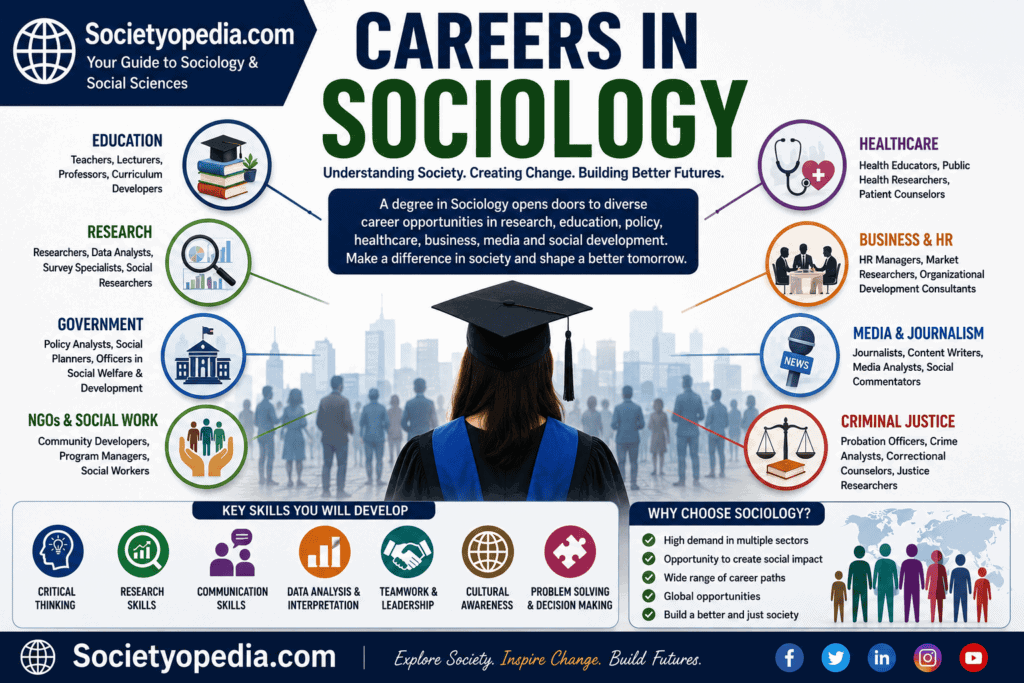
A sociology degree equips students with analytical thinking, research skills, communication abilities, problem-solving techniques, and an understanding of human behavior. These skills are highly transferable and can be applied in various professions.
Sociology graduates are capable of conducting surveys, analyzing statistical data, writing reports, evaluating public policies, designing research projects, managing community development programs, and working with diverse populations. Their ability to understand social structures and institutions allows them to contribute effectively in education, healthcare, governance, business, and social welfare.
Skills Developed Through Sociology
One of the greatest strengths of sociology is the broad range of professional skills it develops. Students learn how to think critically about social issues, analyze complex problems, and interpret both qualitative and quantitative data. They become proficient in research design, data collection, statistical analysis, report writing, and project evaluation.
Sociology also strengthens communication skills through presentations, interviews, group discussions, and academic writing. Graduates develop leadership abilities, teamwork, cultural awareness, ethical reasoning, conflict resolution skills, and the capacity to work effectively with people from different social and cultural backgrounds.
These skills are highly valued by employers in both public and private sectors.
Careers in Education
Education is one of the most common career paths for sociology graduates. Many begin their careers as school teachers, college lecturers, university faculty members, or education consultants. They teach sociology as well as related subjects such as social studies, civics, research methods, gender studies, and anthropology.
Those who pursue higher qualifications, such as an MPhil or PhD, can become university professors, academic researchers, department heads, curriculum developers, or education policy analysts. They may also supervise research projects and contribute to academic publications.
Careers in Research
Research is a major field for sociology graduates because the discipline emphasizes scientific inquiry and evidence-based analysis. Sociologists work as research assistants, research associates, project coordinators, data analysts, monitoring and evaluation officers, and principal investigators.
Research organizations, universities, think tanks, market research firms, and government agencies regularly hire sociology graduates to conduct surveys, analyze social trends, evaluate development programs, and prepare policy reports.
Researchers frequently use statistical software such as IBM SPSS Statistics, R, and Microsoft Excel to analyze research data.
Careers in Government
Government institutions employ sociology graduates in numerous departments related to social welfare, planning, education, labor, public administration, local government, population studies, disaster management, youth affairs, and community development.
Sociologists contribute to policy formulation, social impact assessments, census operations, poverty reduction programs, public awareness campaigns, and community outreach initiatives. They also work in civil service, planning commissions, and development authorities where understanding social issues is essential for effective governance.
Careers in Non-Governmental Organizations (NGOs)
Many sociology graduates build successful careers in NGOs working on education, health, gender equality, human rights, poverty alleviation, child protection, rural development, environmental sustainability, and humanitarian assistance.
Their responsibilities often include conducting community needs assessments, designing development projects, managing field operations, monitoring project implementation, evaluating program effectiveness, writing donor reports, and organizing community awareness campaigns.
NGOs value sociology graduates because they understand community dynamics and participatory development approaches.
Careers in International Organizations
International organizations provide excellent career opportunities for sociology graduates interested in global development. Agencies such as the United Nations, World Health Organization, United Nations Children’s Fund, United Nations Development Programme, World Bank, and International Labour Organization recruit sociology graduates for research, policy analysis, social protection, monitoring and evaluation, gender programs, humanitarian assistance, and sustainable development projects.
Professionals working in these organizations often collaborate with governments, researchers, and local communities to address global social challenges.
Careers in Healthcare
Healthcare organizations increasingly recognize the importance of sociological perspectives in understanding health behaviors, healthcare access, and social determinants of health.
Sociology graduates may work in hospitals, public health departments, healthcare NGOs, rehabilitation centers, mental health organizations, and health research institutes. Their responsibilities include community health education, patient advocacy, health program evaluation, and public health research.
Medical sociology has become an important specialization due to growing interest in healthcare inequalities and patient-centered care.
Careers in Human Resource Management
Human resource management is another attractive field for sociology graduates. Organizations require professionals who understand human behavior, organizational culture, employee motivation, diversity, and workplace relationships.
Sociology graduates may work as recruitment specialists, HR officers, training coordinators, employee relations managers, organizational development consultants, or diversity and inclusion officers.
Their understanding of social interaction helps improve workplace communication and organizational effectiveness.
Careers in Market Research and Business
Businesses increasingly rely on sociological research to understand consumer behavior, market trends, customer satisfaction, and organizational culture.
Sociology graduates work as market researchers, business analysts, customer experience specialists, social researchers, and corporate consultants. They conduct surveys, analyze consumer preferences, evaluate marketing strategies, and help organizations improve products and services.
The ability to interpret social behavior makes sociology graduates valuable in competitive business environments.
Careers in Media and Journalism
Media organizations employ sociology graduates because they possess strong analytical and communication skills. They work as journalists, editors, content writers, social analysts, documentary researchers, media consultants, and communication specialists.
Their understanding of social issues enables them to produce balanced reporting, conduct investigative research, analyze public opinion, and explain complex social events to wider audiences.
Digital media has further expanded opportunities in content creation, social media analysis, and public communication.
Careers in Criminal Justice
Sociology graduates contribute significantly to criminal justice systems through research, policy development, rehabilitation programs, and community policing initiatives.
Career opportunities include probation officers, correctional counselors, victim support specialists, juvenile justice officers, crime analysts, forensic interviewers, and community rehabilitation workers.
Understanding the social causes of crime enables sociologists to support prevention and rehabilitation efforts.
Careers in Social Work and Community Development
Community development remains one of the traditional yet highly rewarding career paths for sociology graduates. Professionals work with marginalized communities to improve education, healthcare, employment, housing, gender equality, and social inclusion.
Their responsibilities often include organizing community programs, conducting needs assessments, facilitating social participation, and evaluating development initiatives.
Many graduates also work as social workers, community organizers, family counselors, youth coordinators, and development officers.
Careers in Public Policy
Public policy organizations require professionals capable of analyzing social problems and evaluating government interventions.
Sociology graduates work as policy analysts, legislative researchers, social planning officers, and public administration consultants.
Their research skills help governments design evidence-based policies addressing education, poverty, employment, healthcare, urban planning, and environmental sustainability.
Emerging Careers for Sociology Graduates
Rapid technological and social changes have created new career opportunities in fields such as social data analytics, digital sociology, user experience (UX) research, diversity and inclusion consulting, corporate social responsibility (CSR), environmental sustainability, artificial intelligence ethics, migration studies, cybersecurity awareness, and social media research.
Organizations increasingly seek professionals who can interpret the social implications of technology and digital transformation.
Career Opportunities in Pakistan
In Pakistan, sociology graduates find employment in universities, colleges, schools, federal and provincial government departments, planning commissions, local governments, public health organizations, police departments, social welfare departments, research institutes, NGOs, international development agencies, media organizations, and private companies.
Competitive examinations and public service commissions also provide opportunities for sociology graduates to enter administrative and policy-related positions.
Higher Education and Academic Growth
Many sociology graduates pursue postgraduate studies such as MPhil and PhD to specialize in areas including medical sociology, gender studies, criminology, environmental sociology, political sociology, development studies, urban sociology, education, and research methodology.
Higher qualifications open opportunities in university teaching, advanced research, consultancy, and international academic collaboration.
Publishing research articles in reputable journals and participating in academic conferences further enhance career prospects.
Future Scope of Sociology
The future of sociology is promising because governments, businesses, and international organizations increasingly recognize the importance of understanding social change. Issues such as artificial intelligence, climate change, migration, aging populations, digital inequality, public health, gender equality, and sustainable development require sociological expertise.
As data-driven decision-making becomes more common, sociology graduates with strong research, statistical, and analytical skills will continue to be in high demand across multiple sectors.
Conclusion
A degree in sociology provides far more than theoretical knowledge about society. It equips graduates with valuable analytical, research, communication, and problem-solving skills that are applicable in education, research, government, healthcare, business, media, criminal justice, international development, and community organizations.
Although many people associate sociology primarily with teaching, the discipline offers diverse and expanding career opportunities in both the public and private sectors. By combining scientific research with an understanding of human behavior and social institutions, sociology graduates play an essential role in addressing contemporary social challenges and promoting sustainable development. For students who are passionate about understanding society and contributing to positive social change, sociology offers a rewarding and meaningful career path.