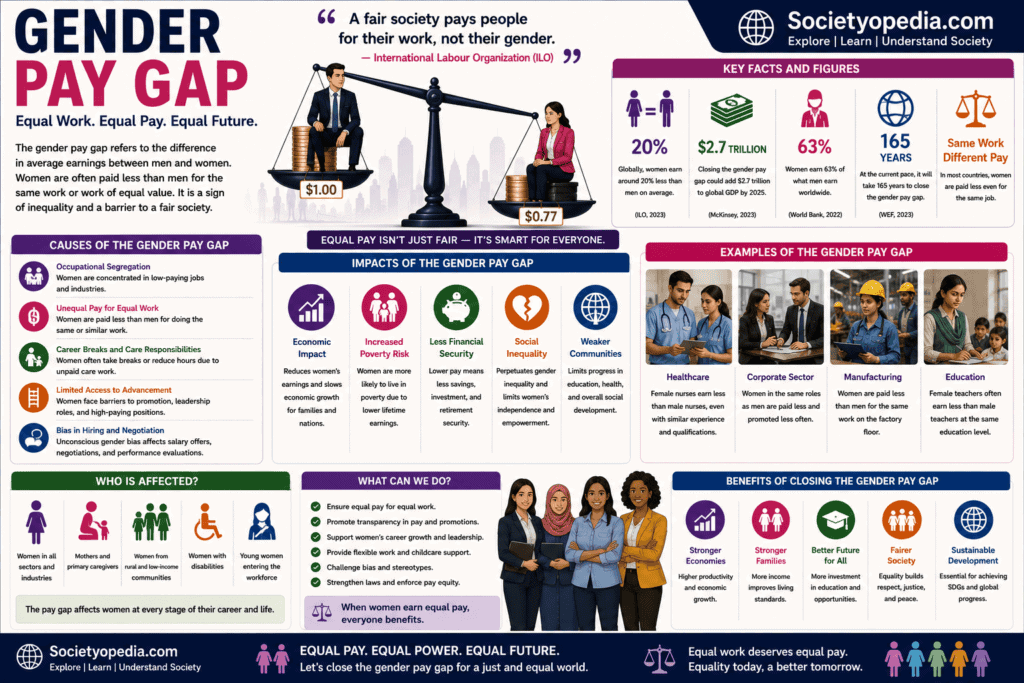
The gender pay gap is one of the most widely discussed forms of gender inequality in employment. It refers broadly to the difference between the average earnings of women and men. The issue is important because income affects economic independence, living standards, savings, family wellbeing, and opportunities throughout the life course.
The gender pay gap is sometimes misunderstood as simply meaning that every woman is paid less than every man for exactly the same job. In reality, the overall pay gap can result from several interconnected factors, including occupational segregation, differences in working hours, career interruptions, unequal representation in leadership, unpaid care responsibilities, education and training, and discrimination.
The International Labour Organization emphasizes the principle of equal remuneration for work of equal value, while recognizing that gender differences in earnings are influenced by multiple labor-market factors.
Understanding the gender pay gap therefore requires a sociological approach that looks beyond individual salaries and examines the structures, institutions, cultural expectations, and social roles that shape employment.
What Is the Gender Pay Gap?
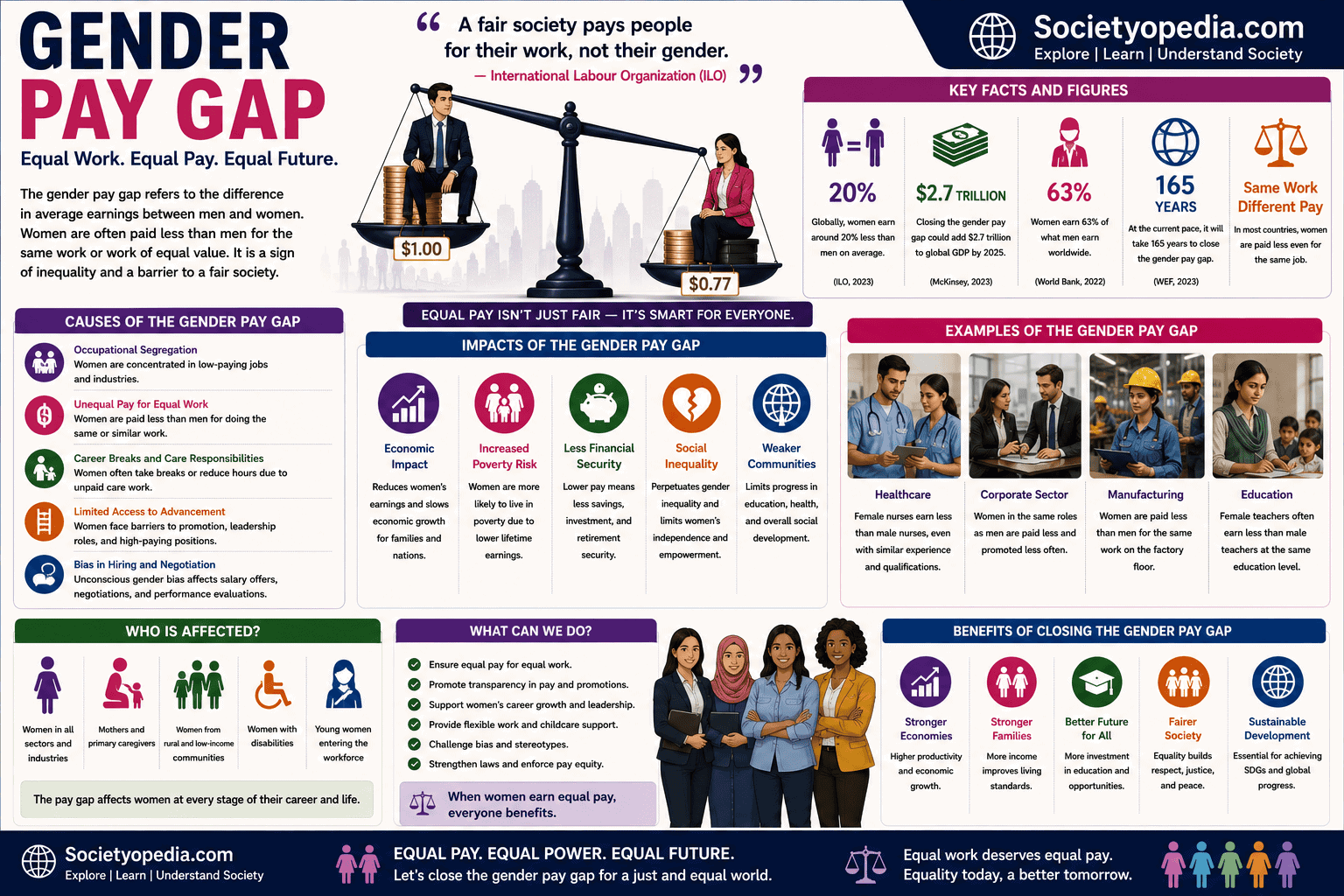
The gender pay gap is the difference between the average earnings of women and men in a labor market or organization.
It is commonly expressed as a percentage.
For example, suppose the average hourly earnings of men are $20 and the average hourly earnings of women are $16.
The difference is $4.
The gender pay gap can be calculated as:
($20 − $16) ÷ $20 × 100 = 20%
This means that women’s average earnings are 20% lower than men’s in this hypothetical example.
The exact measurement can vary depending on whether researchers compare hourly earnings, monthly income, annual earnings, full-time workers, part-time workers, or all employees.
Gender Pay Gap vs Equal Pay
The terms gender pay gap and equal pay are related but should not be treated as identical.
Equal pay means that people should receive equal remuneration for the same work or work of equal value, without discrimination based on gender.
Gender pay gap refers to the overall statistical difference in average earnings between women and men.
An overall gender pay gap can exist even when an organization pays women and men equally for identical jobs.
For example, suppose a company has equal salaries for men and women in each position, but most senior positions are occupied by men while women are concentrated in lower-paid positions.
The organization may still have an overall gender pay gap.
This distinction is essential for understanding the issue accurately.
Why Does the Gender Pay Gap Matter?
Income is closely connected with economic security.
Earnings influence people’s ability to afford housing, education, healthcare, transportation, savings, and other necessities.
Therefore, persistent differences in earnings can produce broader differences in economic wellbeing.
The gender pay gap can also accumulate over a person’s career.
A small difference in annual earnings may become substantial when repeated over many years.
Lower lifetime earnings can also affect savings, pensions, retirement security, and economic independence.
Gender Pay Gap in Sociology
From a sociological perspective, the gender pay gap is not simply an economic statistic.
It reflects relationships between gender, work, family, institutions, culture, and power.
Societies assign different values to occupations and types of work.
Caregiving and domestic work, for example, have historically been associated with women and are often unpaid or comparatively low-paid when performed as formal employment.
At the same time, occupations associated with technical expertise, authority, or physical production may receive higher economic rewards.
Sociologists therefore examine how gender influences the organization and valuation of work.
Major Causes of the Gender Pay Gap
There is no single cause of the gender pay gap.
It is produced by multiple factors that can interact with one another.
Occupational Segregation
Women and men are often concentrated in different occupations.
This is called occupational segregation.
Women may be more strongly represented in education, nursing, social care, administrative work, and other occupations.
Men may be more strongly represented in engineering, construction, transportation, technology, and some technical occupations.
If occupations dominated by women are systematically paid less than occupations requiring similar levels of education or skill, occupational segregation can contribute to the overall pay gap.
Gender Differences in Leadership
Senior positions often come with higher salaries.
If women are underrepresented in senior management, executive roles, corporate boards, or other leadership positions, the average earnings of women can be lower.
This is connected with the concept of the glass ceiling, which describes invisible barriers that restrict advancement into senior positions.
Leadership inequality can therefore contribute to the gender pay gap.
Unpaid Care Work
One of the most important factors is the unequal distribution of unpaid care work.
Household responsibilities include:
- childcare;
- cooking;
- cleaning;
- caring for elderly relatives;
- managing household tasks;
- supporting family members.
When women perform a larger share of these responsibilities, they may have less time available for paid employment.
They may choose part-time work, flexible employment, shorter hours, or career interruptions.
These employment patterns can affect lifetime earnings.
UN Women identifies unequal unpaid care responsibilities as an important factor contributing to women’s economic disadvantage and poverty.
Career Interruptions
Pregnancy, childbirth, childcare, and family responsibilities can interrupt careers.
Career interruptions can affect income because employees may lose professional experience, seniority, promotions, training opportunities, and professional networks.
Even when someone returns to employment after a career break, returning at the same professional level may be difficult.
Repeated interruptions can therefore contribute to long-term differences in earnings.
Part-Time Employment
Part-time employment can provide flexibility for people with family responsibilities.
However, part-time positions may offer lower hourly or annual earnings, fewer benefits, or fewer opportunities for advancement in some labor markets.
If women are disproportionately represented in part-time employment because of unequal caregiving responsibilities, this can contribute to the overall gender pay gap.
It is important to distinguish voluntary part-time employment from part-time work caused by a lack of affordable childcare or suitable full-time opportunities.
Gender Discrimination
Discrimination can also contribute to unequal earnings.
For example, employers may underestimate women’s abilities, offer lower starting salaries, provide fewer opportunities for advancement, or evaluate similar performance differently.
Discrimination may be explicit or subtle.
However, it is important not to assume that the entire gender pay gap is caused by direct discrimination.
Researchers generally examine multiple factors when explaining differences in earnings.
Gender Bias in Salary Negotiation
Salary negotiation can also influence earnings.
Gender expectations can affect how employees are perceived when negotiating.
An assertive male employee asking for a higher salary may be viewed as confident, while an equally assertive female employee may sometimes be perceived negatively.
Such social expectations can influence starting salaries and later earnings.
Because salary increases are often based partly on previous earnings, an initial difference can accumulate over time.
Education and the Gender Pay Gap
Education can influence earnings, but education alone does not eliminate the gender pay gap.
Women in many societies have achieved high levels of educational attainment.
However, differences in fields of study can influence employment and earnings.
If women are concentrated in lower-paid fields while men are concentrated in higher-paid technical or professional fields, average earnings can differ even when educational attainment is similar.
Therefore, researchers examine both level of education and field of education when studying gender differences in earnings.
The Motherhood Penalty
The motherhood penalty refers to employment and earnings disadvantages that mothers may experience.
Employers may assume that mothers are less available, less flexible, or less committed to paid employment.
Mothers may also reduce working hours or take career breaks because of childcare responsibilities.
These factors can contribute to differences in earnings between mothers and fathers.
The motherhood penalty illustrates how gender inequality in family responsibilities can become economic inequality.
The Fatherhood Premium
In some contexts, fathers may experience a fatherhood premium, where parenthood is associated with perceptions of responsibility, stability, or commitment.
This contrasts with the motherhood penalty.
The difference demonstrates that parenthood itself does not necessarily affect women and men in the same way.
Gender expectations influence how employers interpret family responsibilities.
Gender Discrimination: Meaning, Types, Causes, Examples and Effects
The Gender Pay Gap Across the Life Course
The gender pay gap can change at different stages of life.
Early in a career, differences may be relatively small.
As workers gain experience, however, differences in promotions, working hours, leadership positions, and family responsibilities may accumulate.
The gap may therefore become more pronounced during mid-career years.
Later in life, lower lifetime earnings can affect retirement savings and pensions.
This means that the gender pay gap should be understood as a life-course issue, not simply a difference in one year’s salary.
Gender Pay Gap and Unpaid Domestic Labor
Paid employment cannot be separated completely from unpaid domestic work.
Every household requires care and maintenance.
If women perform most unpaid domestic labor, they may have less time and energy for paid work.
This can affect:
working hours → career progression → promotions → income → lifetime earnings
The unequal distribution of unpaid work can therefore indirectly contribute to the gender pay gap.
Gender Pay Gap and Occupational Segregation
Occupational segregation is particularly important.
Consider two hypothetical occupations:
A software engineer earns $70,000 annually.
A childcare worker earns $35,000 annually.
If men are heavily concentrated in software engineering and women are heavily concentrated in childcare, the average earnings of men and women will differ.
The difference does not necessarily mean that every software engineer is paid more than every childcare worker because of gender.
Instead, it demonstrates how gendered patterns of occupational distribution can contribute to aggregate earnings differences.
Horizontal and Vertical Inequality
The gender pay gap can be understood through two forms of occupational inequality.
Horizontal Inequality
Women and men work in different occupations or sectors.
Vertical Inequality
Women and men occupy different levels within the same organization or occupation.
Horizontal segregation can influence which jobs people enter.
Vertical segregation can influence how far they progress.
Together, these patterns can contribute significantly to differences in earnings.
Gender Pay Gap in Developing Countries
The causes and forms of the gender pay gap vary between countries.
In developing economies, gender differences in employment may be strongly influenced by informal work, agriculture, unpaid family labor, limited social protection, education, mobility, childcare, and cultural expectations.
Women may perform substantial economic activity that is not formally recorded or adequately compensated.
Therefore, measuring the gender pay gap can be more difficult when large portions of economic activity occur outside formal employment.
Gender Pay Gap in Pakistan
The gender pay gap is also relevant to Pakistan.
Women’s participation in paid employment is influenced by several factors, including education, family responsibilities, cultural expectations, mobility, transportation, workplace safety, childcare, occupational segregation, and access to formal employment.
Women may be concentrated in certain occupations and sectors, while men may have greater representation in higher-paying technical, managerial, or physically mobile jobs.
Informal and home-based work can also make women’s economic contributions difficult to measure accurately.
The Pakistani context demonstrates why gender pay inequality should be examined together with labor-force participation, unpaid care work, education, culture, family structures, and institutional conditions.
Effects of the Gender Pay Gap
The gender pay gap has consequences at multiple levels.
Economic Dependence
Lower earnings can reduce economic independence.
Household Inequality
Income differences can influence bargaining power within households.
Poverty
Lower lifetime earnings can increase vulnerability to poverty, particularly for single-parent households and older women.
Career Disadvantage
Lower earnings can be connected with fewer opportunities for advancement.
Retirement Inequality
Lower lifetime income can contribute to lower savings and retirement benefits.
Social Inequality
Income differences can reinforce broader patterns of gender inequality.
Gender Pay Gap and Economic Independence
Economic independence allows individuals greater control over their lives.
Income can influence decisions about housing, healthcare, education, transportation, and family responsibilities.
When women have lower earnings or limited access to paid employment, they may become more economically dependent on spouses or family members.
This does not mean that all women without independent income lack decision-making power.
Rather, access to personal economic resources can increase an individual’s options and bargaining power.
Gender Pay Gap and Poverty
The relationship between gender and poverty is significant.
Lower earnings over many years can increase women’s vulnerability to economic hardship.
Women who experience career interruptions, part-time employment, or lower-paid occupations may have fewer savings and less financial protection later in life.
UN Women identifies women’s unequal access to economic resources and unpaid care responsibilities as important dimensions of the relationship between gender inequality and poverty.
Reducing gender inequality in employment can therefore contribute to poverty reduction.
Gender Pay Gap and Families
The gender pay gap can influence family decisions.
When one partner earns substantially more than the other, households may make decisions about employment and caregiving partly around income differences.
For example, a family may decide that the lower-paid partner should reduce working hours to provide childcare.
If the lower-paid partner is a woman, this can reinforce the existing gender pay gap.
This creates a possible cycle:
Lower female earnings → greater caregiving responsibility → fewer working hours → slower career advancement → lower future earnings
Breaking this cycle requires changes in both workplace policies and the distribution of family responsibilities.
Gender Pay Gap and Social Change
Changes in women’s education and employment have transformed gender relations in many societies.
As women enter professional occupations and gain greater economic independence, traditional family roles can change.
However, employment equality cannot be achieved simply by increasing women’s labor-force participation.
Men’s participation in unpaid domestic and caregiving work is also important.
A more equal division of paid and unpaid work can help reduce gender inequality across both family and employment institutions.
How Can the Gender Pay Gap Be Reduced?
There is no single solution because the pay gap has multiple causes.
Equal Pay Policies
Employers should ensure equal remuneration for work of equal value.
Transparent Salary Structures
Clear salary ranges can reduce arbitrary differences in pay.
Fair Recruitment and Promotion
Hiring and promotion decisions should be based on qualifications, experience, performance, and clearly defined criteria.
Affordable Childcare
Accessible childcare can help parents remain in paid employment.
Parental Leave
Parental leave policies that support both mothers and fathers can reduce the assumption that caregiving is primarily women’s responsibility.
Flexible Work
Flexible working arrangements can help employees balance employment and family responsibilities.
Support for Women’s Leadership
Mentoring, training, networking, and leadership opportunities can help reduce vertical occupational segregation.
Challenging Occupational Stereotypes
Girls and women should be encouraged to enter higher-paying fields when they have the interest and ability, while boys and men should also be free to enter caregiving and other traditionally female occupations.
Why the Gender Pay Gap Should Be Studied Carefully
The gender pay gap is an important indicator, but it should not be interpreted without context.
A simple comparison between average male and female earnings does not explain why the difference exists.
Researchers may consider:
- occupation;
- education;
- experience;
- working hours;
- age;
- industry;
- location;
- employment status;
- family responsibilities;
- leadership position.
This is why economists and sociologists distinguish between an unadjusted pay gap and analyses that account for measurable differences between workers.
Even after accounting for observable characteristics, remaining differences require careful interpretation rather than automatically being attributed to one single cause.
Gender Pay Gap and Gender Equality
Reducing the gender pay gap is an important part of gender equality, but it is not the only goal.
Gender equality also involves equal access to education, employment, leadership, political participation, healthcare, social protection, and decision-making.
The pay gap is therefore one indicator within the broader system of gender inequality.
If women have equal education but remain concentrated in lower-paid occupations, occupational inequality remains.
If women receive equal pay but remain excluded from leadership, organizational inequality remains.
A comprehensive approach must therefore address multiple dimensions of gender inequality simultaneously.
Conclusion
The gender pay gap refers to the difference between the average earnings of women and men. It is a major indicator of gender inequality in employment, but it should not be confused with the narrower issue of unequal pay for exactly the same job.
The pay gap can result from occupational segregation, differences in working hours, career interruptions, unpaid care responsibilities, unequal access to leadership, salary negotiation, workplace structures, and discrimination.
Its consequences extend beyond monthly income. Persistent differences in earnings can affect economic independence, household bargaining power, poverty, savings, career development, and retirement security.
Reducing the gender pay gap therefore requires broader social and institutional changes. Equal pay policies, transparent salary systems, affordable childcare, parental leave, flexible working arrangements, fair promotion practices, and greater access to leadership can all contribute to reducing gender-based economic inequality.
Ultimately, understanding the gender pay gap requires looking beyond individual salaries and examining how gender, family, culture, education, employment, institutions, and social norms interact to shape economic opportunities.