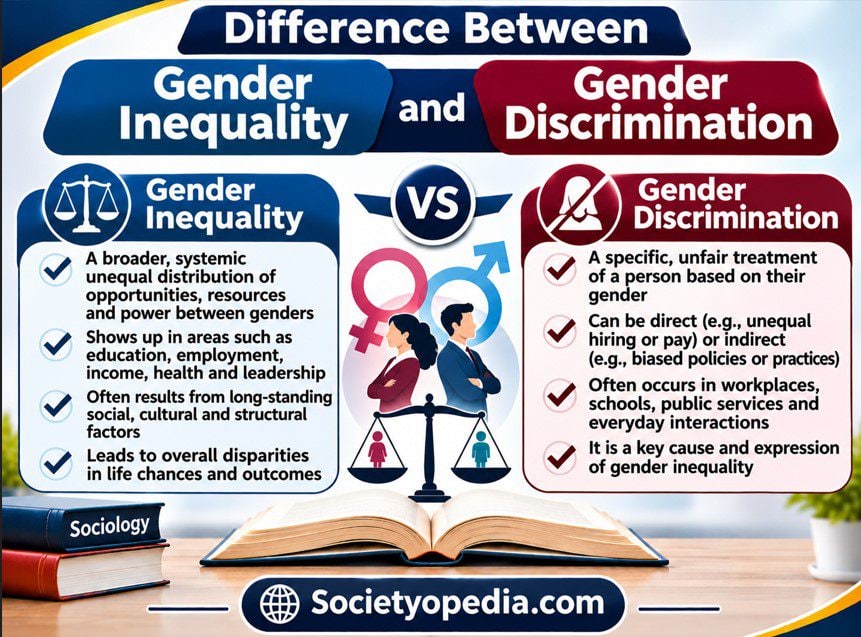
The main difference between gender inequality and gender discrimination is that gender inequality refers to unequal rights, opportunities, resources, or outcomes between genders, while gender discrimination refers to unfair treatment of people because of their gender. Gender inequality describes a broader social condition, whereas gender discrimination is one way that inequality can occur or continue.
Both concepts are important in sociology because they help explain differences in education, employment, healthcare, political participation, and other areas of social life.
What Is Gender Inequality?
Gender inequality means that people experience unequal access to rights, opportunities, resources, or social benefits because of gender. It can exist in families, workplaces, educational institutions, political systems, and other social structures.
For example, if women have fewer opportunities than men to reach senior management positions, this may reflect gender inequality. Similarly, if girls have less access to education than boys in a community, the difference represents gender inequality.
Gender inequality can result from cultural expectations, unequal power relations, economic conditions, institutional practices, and historical disadvantages. It may continue even when no single person openly intends to treat someone unfairly.
What Is Gender Discrimination?
Gender discrimination refers to unfair treatment of a person because of their gender. It occurs when someone is denied opportunities, benefits, rights, or services because of gender-based assumptions or rules.
For example, if an employer rejects a qualified woman because the employer believes that men are more suitable for leadership positions, this is gender discrimination. Similarly, refusing to admit a girl to a school because she is a girl is an example of gender discrimination.
Discrimination can be direct, such as openly refusing to hire someone because of gender. It can also arise through policies or practices that disadvantage a gender without a sufficient justification. Whether a particular practice is unlawful depends on the relevant law and circumstances.
Difference Between Gender Inequality and Gender Discrimination
The difference between gender inequality and gender discrimination becomes clearer when we compare their meanings and effects.
| Basis | Gender Inequality | Gender Discrimination |
|---|---|---|
| Meaning | Unequal rights, opportunities, resources, or outcomes between genders | Unfair treatment based on gender |
| Main focus | The broader condition of inequality | The treatment or practice causing disadvantage |
| Nature | Social, economic, political, or institutional condition | Action, decision, policy, or practice |
| Example | Women are underrepresented in senior leadership | A qualified woman is rejected because of her gender |
| Scope | Can affect entire groups or institutions | Can affect individuals or groups |
| Relationship | May result from multiple social and institutional factors | Can create or reinforce gender inequality |
Examples of Gender Inequality and Gender Discrimination
Consider a workplace where very few women hold senior management positions. This may indicate gender inequality, although researchers would need further evidence to identify its causes.
If the organization refuses to promote qualified women because it believes leadership is a man’s role, that decision is gender discrimination. Repeated decisions of this kind can contribute to the wider pattern of gender inequality.
In education, a difference in school attendance between girls and boys may indicate gender inequality. If families or institutions deliberately deny girls educational opportunities because they are girls, this is an example of gender discrimination.
These examples show that gender discrimination can contribute to gender inequality, but inequality can also arise from several connected social, economic, and institutional factors.
Frequently Asked Questions
1. What is the main difference between gender inequality and gender discrimination?
Gender inequality describes unequal conditions or outcomes between genders, while gender discrimination refers to unfair treatment based on gender.
2. Can gender discrimination cause gender inequality?
Yes. Discriminatory decisions and practices can reduce access to education, employment, leadership, and other opportunities, contributing to wider inequality.
3. Can gender inequality exist without direct discrimination?
Yes. Unequal outcomes can develop through historical disadvantages, social expectations, economic conditions, or institutional structures, even when direct discriminatory behavior is not immediately evident.
4. What is an example of gender inequality in the workplace?
A persistent lack of women in senior leadership positions may indicate gender inequality, although the reasons for that pattern need investigation.
5. Why are these concepts important in sociology?
They help sociologists examine unequal power, access to resources, institutional practices, and the social processes that shape gender relations.
Conclusion
Understanding the difference between gender inequality and gender discrimination helps explain both unequal social conditions and the practices that may produce them. Gender inequality describes the broader problem, while gender discrimination refers to unfair treatment that can contribute to it. Societyopedia.com provides simple explanations of Sociology, Psychology, Gender Studies, Research Methods, Anthropology, Education, and other social science concepts.