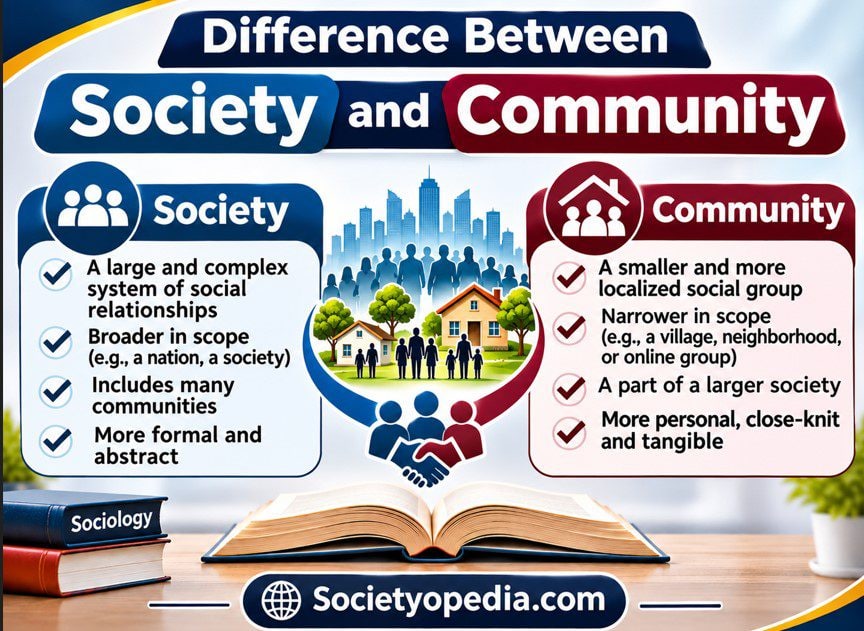
The main difference between society and community is that society refers to a broader network of social relationships, while a community is a group of people who share a place, interests, identity, or sense of belonging. Society includes different groups and institutions, whereas a community usually has a more specific connection among its members.
Both concepts are important in sociology because they help explain how people interact, form relationships, and organize their social lives.
What Is Society?
Society is a group of people who interact with one another and share social relationships, institutions, norms, and cultural practices. It includes different social groups, such as families, schools, religious organizations, workplaces, and political institutions.
For example, a national society includes people from different regions, cultures, occupations, and social classes. These people may not know one another personally, but they are connected through laws, economic systems, social institutions, and shared social arrangements.
Society is a broad concept. It helps sociologists understand social structure, culture, social change, inequality, and relationships between individuals and institutions.
What Is Community?
Community refers to a group of people who share a geographical area, common interests, cultural identity, or a sense of belonging. Community members often interact around shared needs, activities, experiences, or goals.
For example, people living in the same village may form a local community. They may share public spaces, local traditions, schools, and community events. An online community may consist of people from different countries who share an interest in education, gaming, or a particular subject.
A community often provides social support, cooperation, identity, and a feeling of belonging. However, community members do not always have close relationships, and communities can vary greatly in size and organization.
Difference Between Society and Community
The difference between society and community becomes clearer when we compare their main features.
| Basis | Society | Community |
|---|---|---|
| Meaning | A broad network of social relationships | A group connected by place, interests, identity, or belonging |
| Scope | Usually broader | Usually more specific |
| Main connection | Social relationships and institutions | Shared interests, place, identity, or goals |
| Interaction | Members may never meet personally | Members may interact more directly |
| Sense of belonging | May vary across the wider society | Often an important feature |
| Example | The national society of a country | A village community or online learning community |
Examples of Society and Community
Consider a country with millions of people from different cultural and economic backgrounds. These people participate in shared institutions, follow common laws, and engage in social and economic relationships. Together, they form part of a wider society.
Within that society, people living in one neighborhood may form a community. They may work together to improve local services, organize events, or help neighbors in need.
Another example is a university society and a student community. The wider society includes all the social institutions and relationships surrounding education, while a student community may consist of learners connected by a university, subject, or shared academic interests.
These examples show that communities can exist within a wider society, although not every community is limited to one geographical location.
Frequently Asked Questions
1. What is the main difference between society and community?
Society is a broad network of social relationships and institutions, while a community is a group connected by shared place, interests, identity, or belonging.
2. Is a community part of society?
Yes. Many communities exist within a wider society and interact with its institutions, laws, and cultural practices.
3. Can an online group be a community?
Yes. People who share interests, goals, or identities and interact online can form a community even when they live in different places.
4. Which is larger, society or community?
Society is generally broader in scope, while a community usually refers to a more specific group. However, the size of a community can vary.
5. Why are society and community important in sociology?
They help sociologists understand social relationships, group identity, cooperation, institutions, social support, and how people organize their lives.
Conclusion
Understanding the difference between society and community helps explain how people form relationships at different levels of social life. Society provides the broader structure of social relationships and institutions, while communities connect people through shared places, interests, identities, or belonging. Societyopedia.com provides simple explanations of Sociology, Psychology, Gender Studies, Research Methods, Anthropology, Education, and other social science concepts.