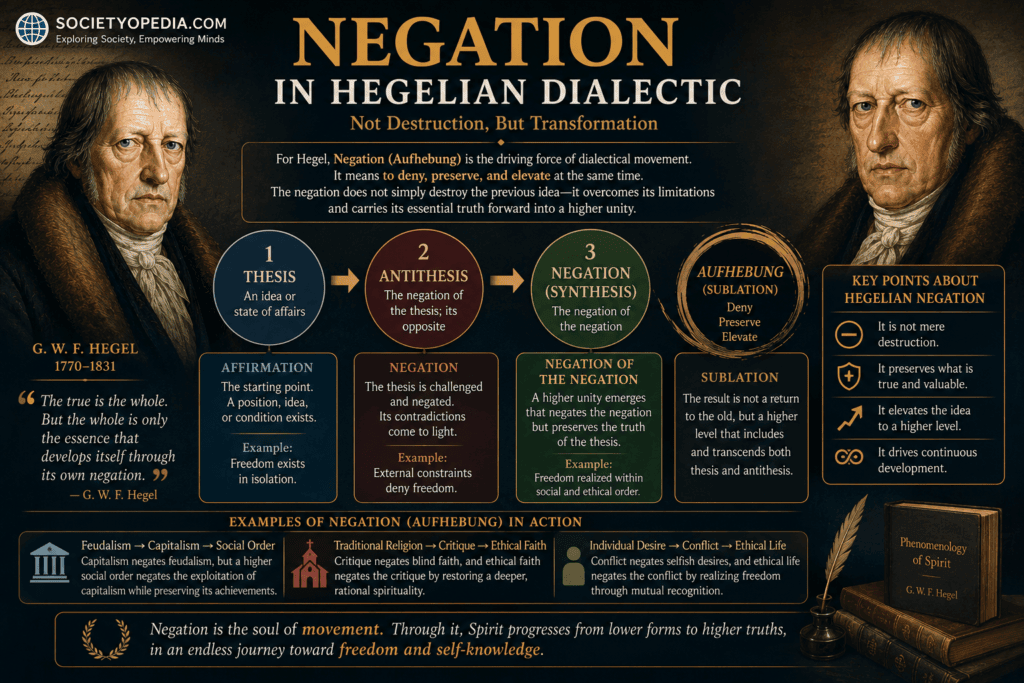
Negation in Hegelian Dialectic is one of the most important ideas for understanding how Georg Wilhelm Friedrich Hegel explains development, change, and transformation. Hegel’s philosophy does not treat reality as permanently fixed. Instead, it examines how concepts, forms of consciousness, and social institutions develop through processes involving limitation, negation, contradiction, and transformation.
In ordinary language, negation usually means saying no, rejecting something, or denying that something is true. In Hegel’s philosophy, however, negation has a broader and more dynamic meaning. Negation is connected with the way things are limited, defined, and transformed. A particular form can be negated because it reveals limitations within itself, and this negation can contribute to the emergence of a more developed form.
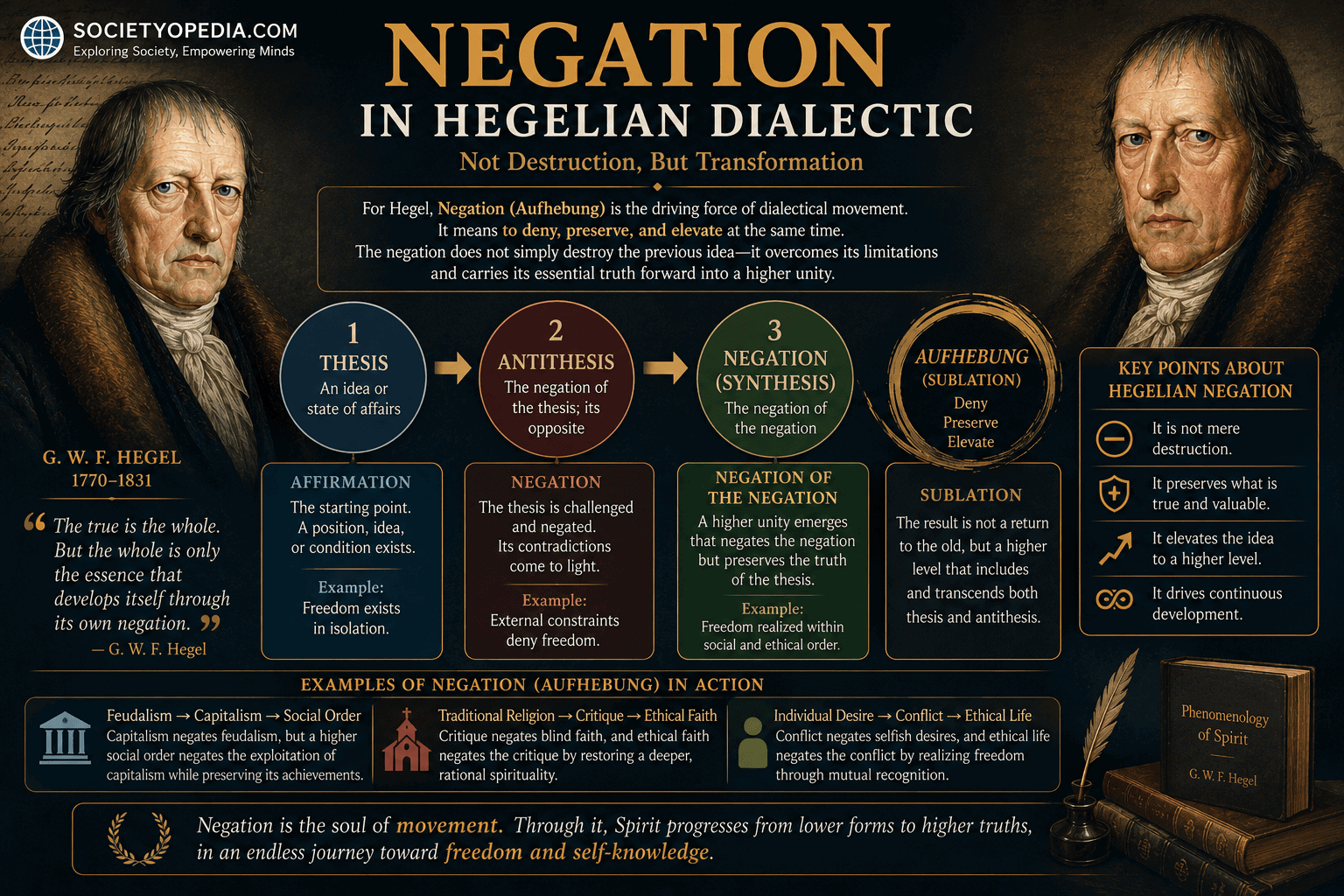
Negation is therefore not simply destruction. It is an important part of dialectical development. Hegel’s philosophy examines how an existing form may be challenged or overcome while elements of it are also preserved and transformed. This process is closely connected with the German concept Aufhebung, commonly translated as sublation.
Hegel’s ideas about negation later influenced Karl Marx, Marxism, critical theory, historical sociology, and theories of social change. Understanding negation is therefore essential for students studying the Hegelian dialectic, contradiction, historical development, and the relationship between philosophy and social theory.
What Does Negation Mean in Hegelian Philosophy?
In its simplest sense, negation refers to the denial or limitation of something.
For example, if we say:
“This object is not red,”
we are negating a particular description.
Hegel’s philosophical understanding of negation goes much further.
For Hegel, a determination is limited. To define something as one thing also means distinguishing it from what it is not.
For example, the concept of “inside” has meaning partly because it is distinguished from “outside.”
Similarly, “freedom” may be understood in relation to forms of restriction or dependence.
This does not mean that every pair of opposites automatically produces dialectical development. Instead, Hegel investigates how determinate forms are connected with their limits and with what they exclude.
Negation is therefore closely connected with determination.
To be something specific is also not to be something else.
Why Is Negation Important in Hegelian Dialectic?
Negation is important because Hegel views development as a process.
If everything remained exactly as it was, development would not occur.
Negation introduces the possibility of transformation.
A particular form may reveal that it is limited or incomplete.
The recognition of this limitation can lead to a new development.
In simplified terms:
- A particular form exists.
- Its limitations become apparent.
- The form is negated or challenged.
- Development leads toward another form.
However, this should not be understood as Hegel’s exact universal formula.
Hegel’s dialectic is not a mechanical sequence.
The process of development differs depending on the concepts and philosophical relationships being examined.
The central point is that negation is a condition of movement and development.
Negation Is Not Simply Destruction
A major misunderstanding is to assume that negation means complete elimination.
In Hegelian philosophy, negation can involve transformation.
An earlier form may be overcome, but aspects of it can remain important within a later form.
This is particularly relevant to Aufhebung.
A dialectical development may:
- Negate an earlier form.
- Preserve certain aspects of it.
- Transform those aspects within a more developed relationship.
Therefore, development can involve both continuity and change.
This makes Hegel’s philosophy more complex than the simple idea that one stage is destroyed and replaced by another.
Determinate Negation
One of Hegel’s most important concepts is determinate negation.
Determinate negation differs from an abstract rejection.
An abstract negation simply says:
“No.”
It rejects something without explaining the specific nature of what is being rejected.
Determinate negation is connected with the particular form being negated.
The limitations of the earlier form contribute to the development of the later form.
This means that dialectical development is not random.
The next development emerges in relation to the specific characteristics and limitations of what came before.
For example, if a social institution claims to provide equal opportunities but certain groups systematically experience barriers, criticism may emerge from the contradiction between the institution’s stated principle and its actual operation.
The demand for change is therefore connected to the specific limitations of the existing institution.
This provides a simple social illustration of determinate negation.
Negation and Contradiction
Negation and contradiction are closely related in Hegel’s philosophy, but they are not identical concepts.
Negation involves limitation, difference, and opposition.
Contradiction involves deeper tensions that can emerge when a particular form contains opposing determinations.
A contradiction can reveal that a form cannot remain stable in exactly the same way.
For example, a political system may promote universal equality while simultaneously restricting meaningful participation to some groups.
The tension between universal equality and restricted participation can become a contradiction within the system.
Negation may occur as existing arrangements are challenged and transformed.
For this reason, contradiction and negation both play important roles in dialectical development.
Negation and Dialectical Development
Hegel’s dialectical philosophy examines development as a process rather than a simple linear movement.
A concept may initially appear complete.
Further examination may reveal limitations.
These limitations can generate negation.
The negation does not necessarily represent an entirely external force.
It may emerge from the internal characteristics of the concept itself.
The process can then lead toward a more developed form.
This is why dialectics is often associated with movement.
Hegel’s philosophy encourages students to examine:
- What a concept claims to be
- What limitations it contains
- What relationships it depends upon
- How these limitations contribute to development
Negation and the Popular Thesis–Antithesis–Synthesis Formula
Negation is often explained through the familiar sequence:
Thesis → Antithesis → Synthesis
However, this model should be used carefully.
The formula is a popular simplification and should not be presented as Hegel’s exact terminology or as a complete description of his philosophical method.
Hegel’s own writings use concepts such as:
- Determination
- Negation
- Contradiction
- Mediation
- Sublation
- Development
The popular three-stage model may help beginners understand the general idea that an existing position can encounter opposition and lead to transformation.
However, it can also create the mistaken impression that every dialectical process follows exactly the same pattern.
Hegel’s dialectical development is more complex.
Negation and Aufhebung
The relationship between negation and Aufhebung is central to Hegel’s philosophy.
Aufhebung is often translated as sublation.
The German term has several meanings that are important for dialectical thinking.
It can involve:
- Cancelling
- Overcoming
- Preserving
- Transforming
This combination explains why dialectical negation is not simply destruction.
An earlier form can be overcome while certain aspects continue within a new form.
For example, a social institution may undergo major reform.
Some practices disappear.
Other functions remain.
The institution develops into a new form.
The example should not be treated as a direct Hegelian historical case. It simply illustrates the relationship between transformation and continuity.
The Negation of Negation
The phrase “negation of the negation” is often associated with dialectical philosophy.
However, students should distinguish carefully between Hegel’s complex philosophical treatment of negation and later simplified uses of the phrase.
The general idea suggests that an initial determination may be negated, and that negation may itself be further transformed.
This can result in a development that does not simply return to the original condition.
Instead, the process may involve transformation at a different level.
A simple illustration can be seen in learning.
A beginner may hold a limited understanding of a subject.
Further study challenges that understanding.
The earlier view is rejected or revised.
However, the learner does not simply return to ignorance.
The earlier knowledge becomes part of a more developed understanding.
This illustration captures the general idea of development through successive transformation, although Hegel’s actual philosophical account is much more complex.
Negation in the Phenomenology of Spirit
Negation plays an important role in Hegel’s Phenomenology of Spirit.
The work examines the development of consciousness through different forms of experience and self-understanding.
A particular form of consciousness may initially believe that it has achieved an adequate understanding of reality.
However, experience can reveal limitations.
The form of consciousness is then challenged.
A new form emerges.
This does not mean that the Phenomenology follows a simple repetitive formula.
Rather, the work traces a complex development in which consciousness encounters problems within its own claims and experiences.
Negation is therefore closely connected with the movement of consciousness.
Negation and the Master–Slave Dialectic
The Master–Slave dialectic also illustrates the importance of negation and transformation.
The struggle for recognition creates a relationship between master and bondsman.
The master appears independent, while the bondsman appears dependent.
However, the relationship contains tensions.
The master depends on the bondsman’s labor.
The bondsman’s work transforms the external world and contributes to the development of self-consciousness.
The original relationship therefore develops in ways that challenge its initial appearance.
The process involves forms of negation because the apparent independence of the master and dependence of the bondsman cannot remain conceptually simple.
For a deeper discussion, an internal link can be added to “The Master–Slave Dialectic Explained: Hegel, Recognition, and Self-Consciousness.”
Negation and Hegel’s Philosophy of History
Negation is also important for understanding Hegel’s philosophy of history.
Hegel viewed historical development as involving changing forms of consciousness, institutions, and freedom.
Historical forms can become limited.
New demands and developments can challenge existing institutions.
A society may therefore undergo transformation.
However, Hegel’s philosophy should not be reduced to the claim that history moves automatically and continuously toward improvement.
Historical development can involve conflict, instability, destruction, and political struggle.
Hegel’s central concern was the development of freedom and Spirit, but this does not mean that every historical event represents simple moral progress.
Negation and Social Change
The concept of negation can help explain social transformation.
Social institutions often contain established rules and practices.
Over time, these arrangements may be challenged.
For example, a social system may establish formal equality while continuing to produce unequal outcomes.
Groups experiencing inequality may question existing arrangements.
Social movements can emerge.
Political reforms may occur.
The earlier structure may be modified rather than completely eliminated.
A dialectical perspective therefore helps explain how change can involve both:
Continuity
and
Transformation
This is one reason Hegel’s ideas remain relevant to sociology.
Negation and Karl Marx
Karl Marx was strongly influenced by Hegelian dialectics.
However, Marx transformed Hegel’s idealist approach into a materialist analysis of society.
Hegel examined negation within the development of concepts, consciousness, and Spirit.
Marx focused more strongly on material and social relationships.
For Marxist theory, contradictions within economic and class structures can contribute to historical transformation.
Marx therefore examined tensions involving:
- Capital and labor
- Property and production
- Economic development and inequality
- Class interests
The comparison can be summarized as follows:
| Hegel | Marx |
|---|---|
| Negation within dialectical development | Contradictions within material social relations |
| Focus on consciousness and Spirit | Focus on production and class |
| German Idealism | Historical Materialism |
| Development of freedom | Transformation of social and economic systems |
Marx did not simply repeat Hegel’s concept of negation.
He transformed dialectical thinking for the analysis of capitalism and historical change.
Negation and Sociology
Although Hegel was not a sociologist in the modern disciplinary sense, his ideas influenced later social theory.
Negation provides a useful way of thinking about how social systems change.
Sociologists may ask:
- What limitations exist within institutions?
- What tensions challenge existing arrangements?
- How do social groups respond to inequalities?
- What aspects of older institutions remain after reform?
- How do continuity and transformation interact?
These questions connect dialectical thinking with historical sociology and the study of social change.
Real-World Illustration: Education and Social Change
Consider an education system that expands access to formal schooling.
This development can create new opportunities.
However, expanded access may also reveal new inequalities.
Some students may have better access to resources, technology, qualified teachers, or economic support.
The expansion of education therefore may solve one problem while revealing others.
Public demands for further reform may emerge.
The system develops again.
A dialectical approach does not assume that the process will produce a perfect educational system.
Instead, it examines how social developments can generate new conditions and new challenges.
This illustrates why negation and contradiction remain useful concepts for understanding change.
Strengths of Hegel’s Concept of Negation
Hegel’s theory of negation has several important strengths.
It Explains Change
Negation provides a framework for understanding why concepts and institutions do not remain permanently fixed.
It Connects Continuity and Transformation
Through Aufhebung, Hegel demonstrates that development can involve both overcoming and preserving earlier forms.
It Encourages Critical Thinking
Students can examine whether apparently stable institutions contain limitations.
It Influenced Major Social Theories
Hegel’s ideas influenced Marxism, critical theory, historical sociology, and theories of social transformation.
It Emphasizes Process
Hegel encourages us to study reality historically and dynamically rather than as a collection of fixed objects.
Criticisms and Limitations
Hegel’s concept of negation also has limitations.
Abstract Terminology
Hegel’s philosophical language can be difficult to understand.
Terms such as negation, contradiction, and sublation require careful interpretation.
Risk of Mechanical Interpretation
Later explanations sometimes treat negation as an automatic formula.
Real historical and social change is more complex.
Difficulty of Empirical Application
Negation is a philosophical concept and cannot always be directly measured in sociological research.
Researchers must connect theoretical concepts with observable social processes.
Risk of Determinism
Some interpretations suggest that negation necessarily leads to progress.
Historical outcomes are not guaranteed.
Social transformation can involve reform, conflict, regression, or unintended consequences.
Contemporary Relevance of Negation
Negation remains relevant because contemporary societies continue to experience rapid transformation.
Technological development creates new opportunities while challenging older forms of work.
Economic growth can coexist with inequality.
Political institutions can promote equality while citizens experience unequal access to resources.
Social movements often emerge when groups challenge existing arrangements.
A dialectical approach encourages students to examine how these processes develop.
Rather than asking only whether a development is positive or negative, dialectical thinking asks:
What new possibilities does this development create?
What new limitations or tensions does it also produce?
This perspective remains valuable for sociology, philosophy, political science, and social theory.
Frequently Asked Questions
What is negation in Hegelian dialectic?
Negation in Hegelian dialectic refers to the limitation, opposition, or overcoming of a particular form. It is an important part of dialectical development and transformation.
Is negation the same as destruction for Hegel?
No. Negation is not simply destruction. Through dialectical development, an earlier form may be overcome while certain aspects are preserved and transformed.
What is determinate negation?
Determinate negation is a specific negation connected with the particular nature and limitations of what is being negated. It differs from an abstract rejection.
What is the relationship between negation and contradiction?
Negation involves limitation and opposition, while contradiction involves deeper tensions within a form or relationship. Both concepts are important in Hegelian development.
What is the negation of negation?
The negation of negation refers broadly to a process in which an initial form is negated and that negation is itself transformed, producing further development rather than simply returning to the original condition.
What is Aufhebung in Hegel’s philosophy?
Aufhebung, commonly translated as sublation, refers to a complex process involving overcoming, preserving, and transforming an earlier form.
How did Marx use Hegelian negation?
Marx was influenced by Hegel’s dialectical method but transformed it into a materialist analysis of class relations, production, and historical change.
Why is negation important in sociology?
Negation provides a philosophical framework for examining how social institutions are challenged, transformed, and historically developed.
Conclusion
Negation in Hegelian Dialectic is essential for understanding Hegel’s philosophy of development. Negation is not simply the rejection or destruction of something. It is connected with limitation, contradiction, transformation, and the emergence of more developed forms.
The concept becomes particularly important through determinate negation and Aufhebung. These ideas demonstrate that historical and philosophical development can involve both continuity and change. Earlier forms may be overcome, but aspects of them can remain within new relationships.
Hegel’s concept of negation influenced Karl Marx and later traditions of Marxism, critical theory, historical sociology, and social change. Marx transformed dialectical ideas into an analysis of material production, class relations, and historical conflict.
For students of philosophy and sociology, negation provides an important way of understanding why societies, institutions, and forms of consciousness do not remain permanently fixed. It encourages us to examine their limitations, the tensions they contain, and the ways they may be transformed.
Understanding negation therefore provides a strong foundation for studying Hegelian dialectic, contradiction, Aufhebung, historical development, Marxism, and social change.