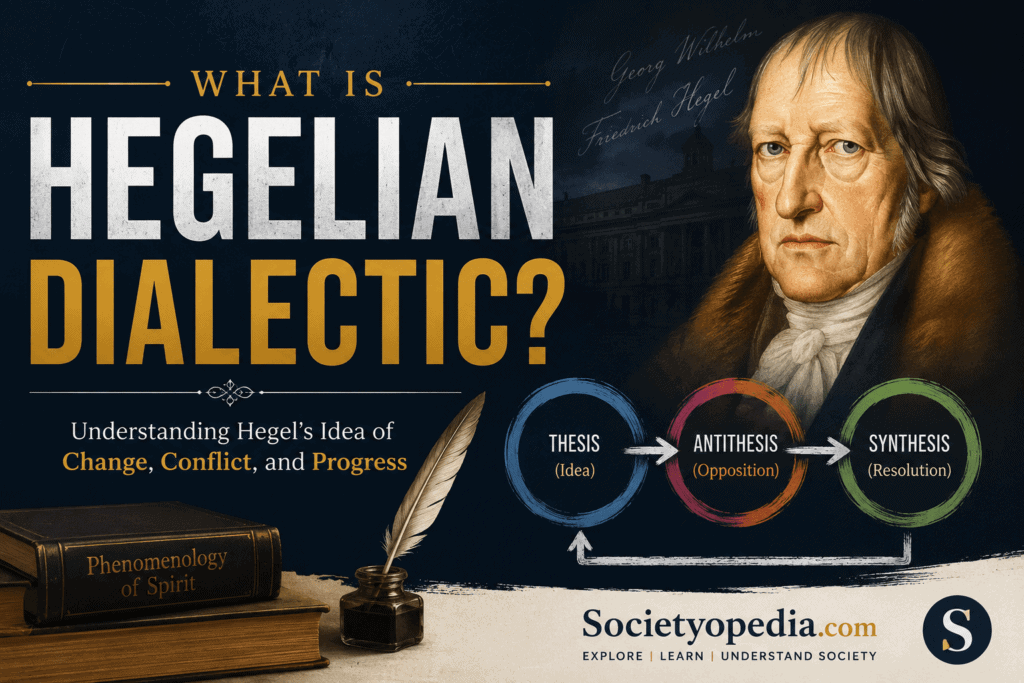
What Is Hegelian Dialectic? Hegelian Dialectic is Georg Wilhelm Friedrich Hegel’s distinctive way of explaining how concepts, forms of consciousness, social institutions, and historical developments change through internal tensions and contradictions. Rather than treating reality as fixed and unchanging, Hegel understood development as a dynamic process in which a particular position or form reveals its limitations, generates a contradiction or negation, and develops into a more comprehensive form.
The German philosopher Georg Wilhelm Friedrich Hegel (1770–1831) developed his mature philosophical system during the early nineteenth century. His dialectical method appears throughout major works including Phenomenology of Spirit (1807), Science of Logic (1812–1816), Encyclopaedia of the Philosophical Sciences, and Philosophy of Right. The dialectic became one of the defining characteristics of his philosophy.
Hegelian dialectic is important not only in philosophy but also in sociology, social theory, political thought, historical sociology, Marxism, and critical theory. It provides a way of examining how apparently opposing forces can be related and how tensions within existing arrangements can contribute to transformation.
What Does Hegelian Dialectic Mean?
The word dialectic has a much older history than Hegel. Ancient Greek philosophy, particularly the dialogues of Plato, used dialectical discussion to examine competing claims and refine philosophical understanding. Hegel inherited this tradition but transformed it into a systematic account of development.
For Hegel, dialectic is not simply a debate between two people. It describes a process in which a concept or form contains limitations that become visible through its own development. Those limitations generate a form of negation, and the resulting tension leads to a more developed determination.
This means that contradiction is not necessarily an accidental mistake. In Hegel’s philosophy, contradiction can reveal that a particular way of understanding something is incomplete.
A useful simplified sequence is:
A position → recognition of its limitation → negation → development into a more comprehensive position
However, this should not be confused with a mechanical formula in which every historical event simply follows three predetermined steps.
Hegel’s Dialectical Method
Hegel’s mature dialectical method is particularly visible in his Science of Logic and Encyclopaedia Logic. He describes three important “moments” of thinking: the moment of the understanding, the dialectical or negatively rational moment, and the speculative or positively rational moment. These are not simply three chronological stages that every argument must mechanically pass through.
The Moment of Understanding
The first moment treats a concept as relatively fixed and determinate. We identify something and distinguish it from other things.
For example, a society may understand individual freedom primarily as freedom from external interference. This conception captures something important, but it may also be incomplete.
The Dialectical or Negatively Rational Moment
The second moment exposes the limitations or one-sidedness of the initial determination. The concept begins to reveal tensions within itself.
In the example of freedom, complete freedom understood only as freedom from others may conflict with the social conditions required for individuals to exercise meaningful freedom.
The original concept therefore cannot remain unchanged.
The Speculative or Positively Rational Moment
The third moment does not merely destroy the earlier position. It incorporates what was valid in it while overcoming its limitations within a richer conception.
Hegel calls this movement determinate negation. The negation is “determinate” because it does not simply produce nothing; it contributes to the emergence of a new and more developed determination.
This is one of the most important ideas for understanding Hegelian dialectic.
Is Hegel’s Dialectic Really “Thesis, Antithesis, Synthesis”?
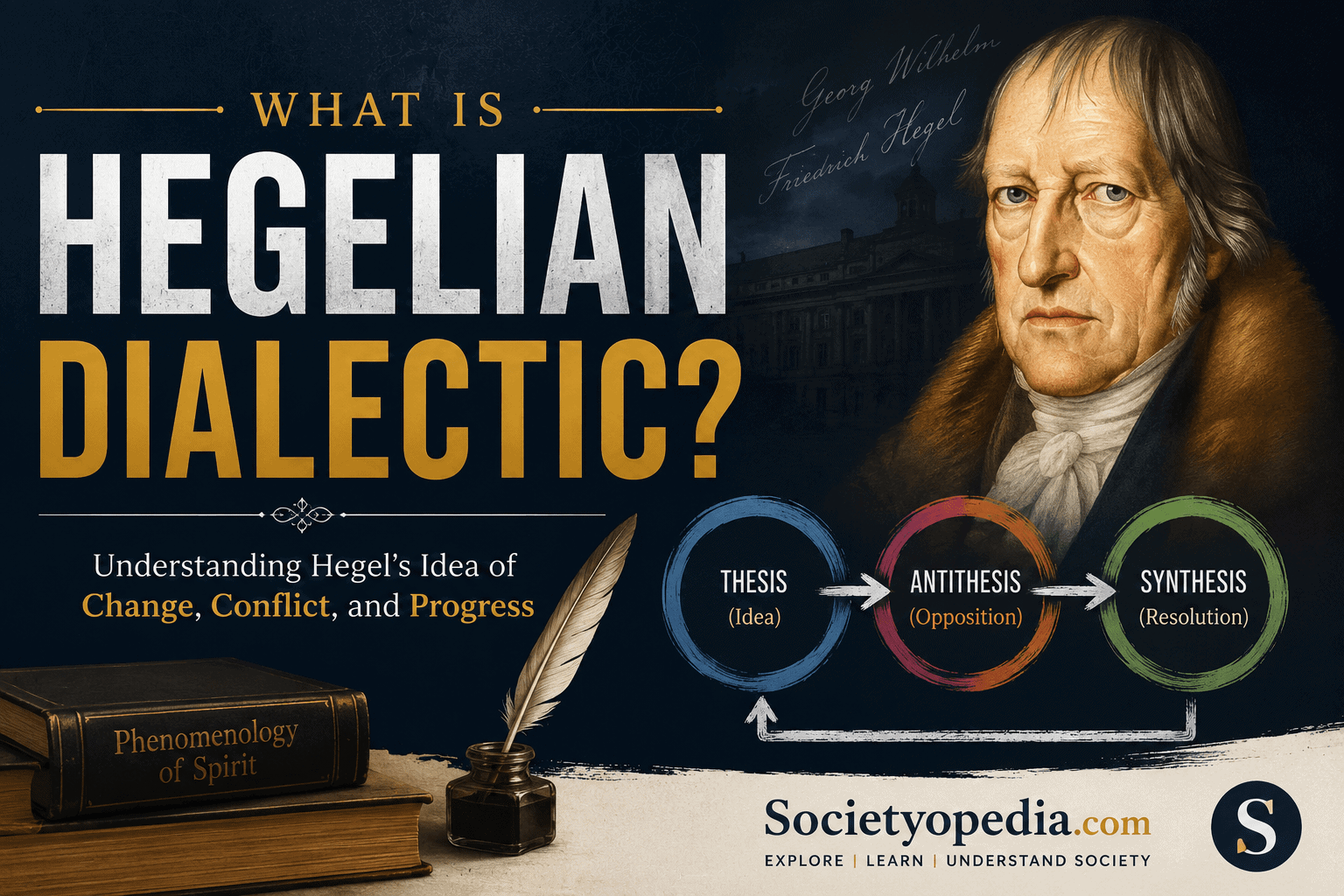
The expression “thesis–antithesis–synthesis” is widely associated with Hegelian dialectic. It is useful as a simplified teaching model, but it requires an important qualification.
Hegel did not present his own philosophical method as a universal formula explicitly called “thesis, antithesis, synthesis.” Scholars have pointed out that this terminology does not accurately describe the structure of Hegel’s philosophy in every case. Hegel himself criticized attempts to impose a rigid tripartite schema onto philosophical content.
The formula can therefore be used cautiously as an introductory illustration rather than as Hegel’s exact terminology.
| Popular formulation | More accurate Hegelian interpretation |
|---|---|
| Thesis | An initial determination or position |
| Antithesis | Its negation or internally generated opposition |
| Synthesis | A higher or more comprehensive determination |
| Fixed three-step formula | Dynamic process of development |
| External opposition | Internal tension and contradiction |
| Simple replacement | Negation that can preserve and transform aspects of what came before |
A famous example often used to explain the general pattern is Hegel’s movement from Being to Nothing to Becoming in the Science of Logic. Yet even here, scholars caution against turning this example into a universal template for every part of Hegel’s philosophy.
Contradiction and Negation in Hegelian Dialectic
Contradiction is central to Hegel’s conception of development.
A limited concept attempts to explain something, but its own implications reveal what it cannot adequately explain. The resulting contradiction creates pressure for conceptual development.
Consider the relationship between individual independence and social dependence. A person may understand freedom as complete independence from others. Yet human beings acquire language, education, institutions, rights, and opportunities through social relationships. Individual freedom therefore cannot be understood entirely apart from social conditions.
For Hegel, the solution is not simply to choose one side. A more developed conception seeks to understand how individual freedom can exist through appropriate social relationships and institutions.
This illustrates an important feature of Hegelian dialectic: development involves both overcoming and preserving.
The German term Aufhebung is particularly important here. It can convey meanings such as cancelling, preserving, lifting up, or overcoming. A later stage can therefore negate an earlier stage while retaining elements of its significance within a more comprehensive whole.
The Master–Slave Dialectic and Recognition
One of the most famous applications of Hegelian dialectic appears in the Phenomenology of Spirit, where Hegel discusses self-consciousness, recognition, and the relationship between master and slave.
Hegel argues that self-consciousness is fundamentally connected to recognition by another self-conscious being. An individual cannot achieve a fully developed sense of self simply in isolation.
The famous Master–Slave dialectic describes a struggle in which two self-conscious beings seek recognition. The relationship becomes unequal: one becomes the master and the other the slave. Yet the apparent victory of the master creates a problem. The master receives recognition from someone whose status has been subordinated, meaning that the recognition is inadequate.
The slave, meanwhile, develops a relationship with work, nature, discipline, and transformation. Through this process, the slave can develop forms of self-consciousness that complicate the original relationship of domination.
The deeper lesson is that recognition cannot be adequately secured through one-sided domination. Genuine recognition requires reciprocal recognition between autonomous persons.
This idea has had a major influence on later theories of identity, social recognition, freedom, and social relations.
Hegelian Dialectic, History, and Social Change
Hegel did not regard history as a random collection of events. He interpreted historical development through changing forms of human consciousness, institutions, freedom, and social life.
For Hegel, the development of freedom is particularly important. Human beings gradually develop more conscious understandings of freedom, while social and political institutions attempt to embody those understandings.
This does not mean that every historical event is automatically progressive or morally good. Hegel’s philosophy of history is considerably more complex than the popular claim that “history always gets better.”
His broader social philosophy connects freedom with institutions and forms of ethical life. Family, civil society, and the state are examined as interconnected structures through which freedom becomes socially actualized.
This makes Hegelian dialectic especially relevant to historical sociology, because it encourages researchers to examine social structures as changing relationships rather than isolated and permanent entities.
Hegelian Dialectic and Sociology
Hegel was a philosopher rather than a sociologist in the modern disciplinary sense, but his ideas strongly influenced later social theory.
Sociologists can find several useful ideas in Hegelian dialectic:
- Social institutions can contain internal tensions.
- Social relationships shape individual consciousness.
- Recognition is important for human identity.
- Social change can emerge from contradictions within existing arrangements.
- Freedom depends partly on social and institutional conditions.
- Historical development involves transformations in consciousness and social organization.
For example, consider a society that formally recognizes equality while maintaining institutions that systematically produce unequal opportunities. A dialectical analysis would not simply compare the legal principle with social reality. It would investigate the tension between the principle of equality and the institutional structures that limit its realization.
Such analysis can help researchers ask how contradictions within social arrangements generate demands for institutional reform.
Hegelian Dialectic and Marxism
Hegel had an enormous influence on Karl Marx, although Marx did not simply reproduce Hegel’s philosophy.
Hegel’s dialectic was fundamentally connected to German idealism, in which the development of concepts, consciousness, and Spirit plays a central role. Marx transformed dialectical analysis within a materialist framework, placing greater emphasis on material production, economic relations, class relations, and historical social structures.
Marx’s relationship with Hegel is therefore often described as a transformation rather than simple rejection. Marx retained important elements of dialectical thinking while criticizing Hegel’s idealism.
This distinction is crucial when studying Hegel and Marx. Hegelian dialectic should not automatically be equated with Marxist dialectical materialism.
| Hegelian dialectic | Marxist dialectical approach |
| Grounded in German idealism | Grounded in materialist social analysis |
| Emphasizes concepts, Spirit, consciousness, and freedom | Emphasizes material conditions, production, and class relations |
| Development of forms of thought and social institutions | Development of material and social relations |
| History connected with development of freedom | History strongly analyzed through modes of production and class conflict |
| Philosophical idealism | Materialist reinterpretation of dialectical development |
Marx’s transformation of Hegel became foundational for later Marxist theories of social change, class conflict, ideology, and historical development.
An Example of Dialectical Social Change
Suppose a society formally establishes a principle of equal political citizenship. At the same time, particular groups remain excluded from meaningful participation.
The contradiction is between the universal principle of political equality and its limited institutional realization.
Social movements may emerge to challenge this contradiction. Their demands can lead to reforms that expand participation.
The new institutional arrangement may solve some problems while creating new tensions. For example, formal political equality may be achieved while economic inequality continues to influence political participation.
This illustrates why dialectical analysis treats social development as an ongoing process rather than a final state in which every contradiction disappears.
Why Is Hegelian Dialectic Important?
Hegelian dialectic remains significant because it challenges static ways of thinking.
Instead of asking only, “What is this institution?” a dialectical approach can ask:
How did it develop? What contradictions does it contain? What assumptions sustain it? What happens when those assumptions conflict with its actual consequences?
This approach can be particularly useful for students studying:
- Philosophy
- Sociology
- Political sociology
- Social change
- Historical sociology
- Marxism
- Critical theory
- Political philosophy
It encourages attention to relationships, processes, contradictions, historical development, and transformation.
Applications of Hegelian Dialectic
Hegelian ideas can be applied as an interpretive framework to examine philosophical and social development.
In sociology, dialectical reasoning can help analyze tensions between individual agency and social structure, equality and inequality, social stability and change, or universal rights and institutional practices.
In political philosophy, it can illuminate relationships between freedom, law, recognition, and political institutions.
In historical sociology, it can encourage analysis of how institutions develop through changing social relationships rather than treating historical structures as permanent.
In critical theory, Hegel’s ideas concerning recognition, contradiction, consciousness, and social freedom have remained especially influential.
Strengths of Hegelian Dialectic
One major strength is its emphasis on development. Hegel encourages researchers to understand phenomena historically rather than treating them as static.
Another strength is its attention to internal contradictions. Instead of viewing contradictions merely as logical errors, dialectical analysis asks whether contradictions reveal limitations within an existing position.
Its emphasis on relationships is also valuable. Concepts such as self-consciousness and recognition demonstrate that individuals cannot always be understood independently of their social relationships.
Finally, Hegelian dialectic provides a framework for connecting ideas, institutions, history, and social transformation.
Criticisms and Limitations
Hegelian dialectic has also attracted substantial criticism.
First, Hegel’s writing is famously difficult. His terminology and arguments are complex, and simplified explanations can easily distort his position.
Second, the popular thesis–antithesis–synthesis formula can make Hegel appear more mechanical than he actually is. Hegel’s dialectical development does not consist of a universal three-step procedure.
Third, critics have questioned aspects of Hegel’s philosophy of history, particularly interpretations that portray history as moving toward a predetermined rational culmination.
Fourth, Hegel’s idealism became a major point of disagreement for materialist thinkers such as Marx. Marxist approaches retain dialectical insights while rejecting Hegel’s idealist foundation.
These criticisms do not make Hegelian dialectic irrelevant. Instead, they demonstrate why it should be studied critically and in relation to Hegel’s actual texts.
Hegelian Dialectic and Contemporary Social Analysis
Hegelian dialectic remains relevant because contemporary societies continue to experience tensions between competing principles and social realities.
Questions concerning equality, recognition, identity, freedom, institutions, political participation, and social exclusion can all involve relationships between universal principles and their incomplete realization.
Contemporary scholars do not necessarily accept Hegel’s entire philosophical system. Nevertheless, concepts such as contradiction, recognition, negation, development, and social freedom continue to provide useful intellectual tools.
The continuing influence of Hegel is particularly visible in traditions of Marxism, social philosophy, critical theory, recognition theory, and historical approaches to social change.
Frequently Asked Questions About Hegelian Dialectic
What is Hegelian dialectic in simple terms?
Hegelian dialectic is a way of understanding development through contradictions and their transformation. A concept or social form can reveal limitations within itself, leading to a more comprehensive form of understanding.
What are the three stages of Hegelian dialectic?
The popular description is thesis, antithesis, and synthesis. However, this is a simplified interpretation rather than Hegel’s own universal terminology. Hegel more precisely discusses moments involving understanding, dialectical negation, and speculative or positively rational development.
Did Hegel use the term “thesis, antithesis, synthesis”?
Not as the universal formula often attributed to him. Hegel’s actual method is more complex, and scholars caution against treating thesis–antithesis–synthesis as a mechanical description of his philosophy.
What is contradiction in Hegelian philosophy?
Contradiction occurs when a determination or concept reveals tensions or limitations that prevent it from remaining adequate in its original form. Contradiction can therefore become a source of further development.
What is determinate negation?
Determinate negation is a central Hegelian idea in which negation produces a specific result rather than simply nothing. The new determination emerges from and responds to what was negated.
What is the Master–Slave dialectic?
The Master–Slave dialectic is Hegel’s analysis of self-consciousness, recognition, domination, and dependence. It demonstrates why genuine recognition cannot be fully achieved through a one-sided relationship of domination.
How did Marx use Hegelian dialectic?
Marx was deeply influenced by Hegel but transformed dialectical analysis through a materialist approach. Marx emphasized material production, class relations, and social structures rather than Hegel’s idealist conception of Spirit and conceptual development.
Why is Hegelian dialectic important in sociology?
It helps sociologists examine social structures as historical and changing phenomena. It draws attention to contradictions, relationships, institutional tensions, recognition, and the processes through which societies transform.
Conclusion
Hegelian Dialectic is one of the most influential approaches to understanding development in modern philosophy and social thought. Developed by Georg Wilhelm Friedrich Hegel, it explains development through the movement of concepts and forms that reveal internal limitations, undergo negation, and develop into more comprehensive determinations.
The popular thesis–antithesis–synthesis formula can help beginners visualize dialectical development, but it should not be treated as Hegel’s exact universal method. Hegel’s actual philosophy is centered more deeply on contradiction, determinate negation, development, Aufhebung, consciousness, recognition, freedom, history, and Spirit.
For sociology and the wider social sciences, the lasting value of Hegelian dialectic lies in its insistence that social reality must be understood dynamically. Institutions, identities, ideas, and forms of social organization develop through relationships and tensions rather than existing as isolated and unchanging entities.
For students of philosophy, sociology, social sciences, historical sociology, Marxism, and critical theory, understanding Hegelian dialectic therefore provides an important foundation for studying later theories of social change, contradiction, recognition, conflict, and historical development.