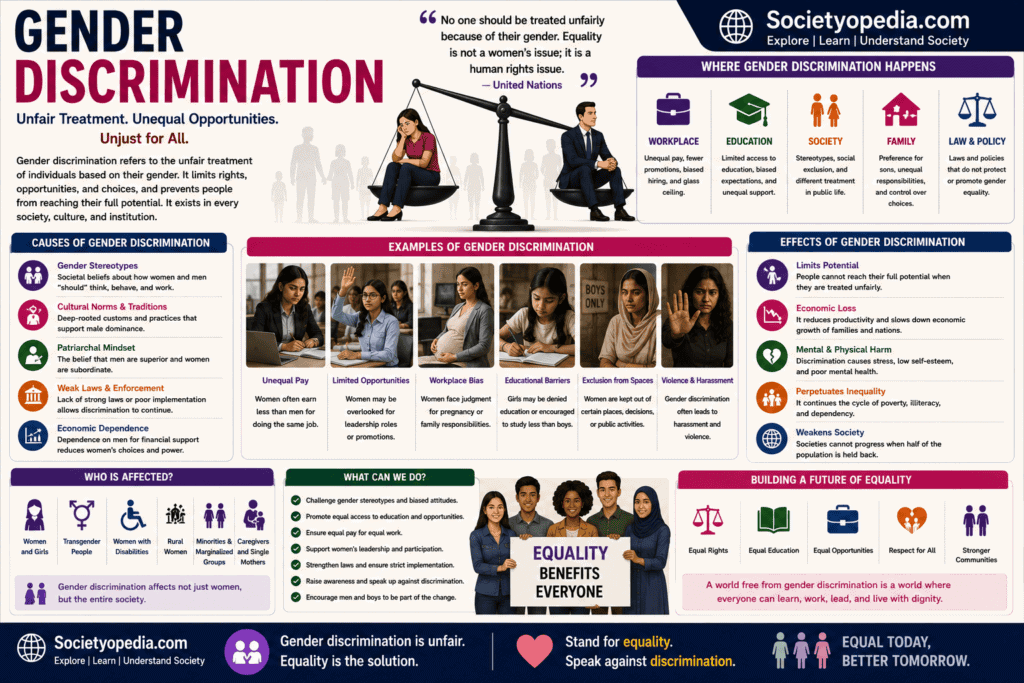
Gender discrimination is an important concept in sociology and gender studies because it helps explain how people can receive unequal treatment, opportunities, rights, or social recognition because of gender. It can occur in families, schools, workplaces, political institutions, healthcare systems, media, and everyday social interactions.
Gender discrimination is closely related to gender inequality, but the two concepts are not exactly the same. Gender inequality refers to unequal outcomes, resources, opportunities, rights, or power, while gender discrimination refers to unfair distinctions, exclusions, restrictions, or preferences based on gender that can produce or reinforce those inequalities.
The International Labour Organization explains discrimination in employment as distinctions, exclusions, or preferences that place people at a disadvantage because of characteristics such as sex when those characteristics are unrelated to the requirements of the job. It also distinguishes between direct and indirect discrimination.
Understanding gender discrimination is therefore essential for understanding gender inequality, gender bias, gender stereotypes, workplace inequality, educational inequality, and broader processes of social change.
What Is Gender Discrimination?
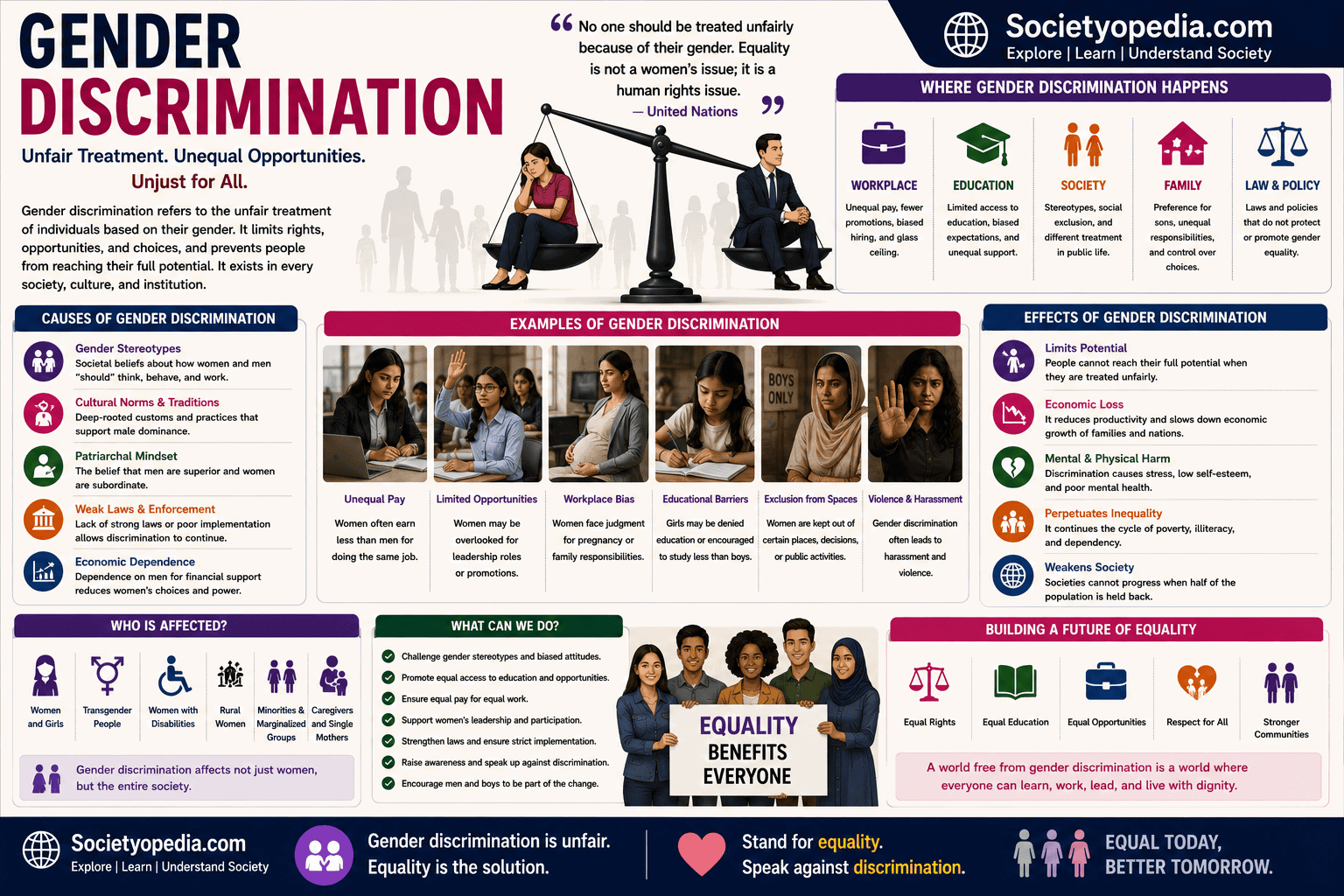
Gender discrimination is the unfair or unequal treatment of a person or group because of gender, particularly when such treatment restricts rights, opportunities, resources, participation, or equal treatment.
Discrimination may be intentional or unintentional. It can be obvious and direct, or it can occur through apparently neutral rules and practices that have unequal effects.
The Convention on the Elimination of All Forms of Discrimination against Women (CEDAW) defines discrimination against women broadly as distinctions, exclusions, or restrictions based on sex that impair or prevent women from enjoying human rights and fundamental freedoms on an equal basis with men.
Although women and girls have historically experienced extensive gender discrimination in many societies, a sociological understanding of gender discrimination also recognizes that gender expectations can affect people of different genders in different contexts.
Gender Discrimination in Sociology
Sociologists study gender discrimination as both an individual and structural phenomenon.
At the individual level, discrimination can occur when one person treats another unfairly because of gender.
For example, an employer might reject a qualified woman because the employer assumes that women are less suitable for demanding professional positions.
At the institutional level, discrimination can occur through organizational rules, practices, or cultures that systematically disadvantage one gender.
At the broader structural level, discriminatory norms can become embedded within social institutions and contribute to persistent patterns of inequality.
This distinction is important because gender discrimination cannot always be identified simply by looking for openly discriminatory statements.
Gender Discrimination and Gender Inequality
Gender discrimination and gender inequality are closely connected.
Gender discrimination refers to discriminatory treatment or practices based on gender.
Gender inequality refers to unequal outcomes, opportunities, resources, rights, responsibilities, or power.
Discrimination can be one of the mechanisms that produces inequality.
For example, if qualified women are repeatedly denied promotions because of gender, discriminatory decisions can eventually produce a workplace where men occupy most senior positions.
Therefore:
Gender discrimination → unequal treatment → unequal opportunities → gender inequality
However, inequality can also arise through mechanisms that are not easily identifiable as individual discriminatory decisions. Institutional structures, historical patterns, social norms, and unequal divisions of responsibility can all contribute to inequality.
Types of Gender Discrimination
Gender discrimination can take several forms. The most important distinction is between direct and indirect discrimination, although discrimination can also occur through institutional practices, stereotypes, harassment, and unequal access to opportunities.
Direct Gender Discrimination
Direct discrimination occurs when a person is explicitly treated differently because of gender.
For example, an employer might advertise a position as being available only to men despite there being no legitimate job-related reason for excluding women.
Another example would be refusing to promote an employee specifically because she is a woman.
The ILO identifies explicit distinctions, preferences, or exclusions as examples of direct discrimination.
Direct discrimination is often easier to identify because the unequal treatment is relatively visible.
Indirect Gender Discrimination
Indirect discrimination is more subtle.
It occurs when a rule or practice appears neutral but disproportionately disadvantages a particular gender.
For example, an organization might require all employees seeking promotion to work extremely long and inflexible hours. On the surface, the rule applies equally to everyone. However, if women are disproportionately responsible for unpaid childcare and domestic work, the requirement may create a greater practical barrier for them.
The ILO specifically distinguishes indirect discrimination as apparently neutral measures or practices that have negative effects on particular groups.
Indirect discrimination can therefore be difficult to recognize because the discriminatory outcome may not be explicitly stated.
Gender Discrimination in Education
Education is an important area in which gender discrimination can occur.
Discrimination may involve unequal access to educational opportunities, discouraging students from particular fields, different expectations from teachers, or unequal treatment in classrooms.
For example, girls may be discouraged from studying engineering, computer science, mathematics, or other subjects because of stereotypes that these fields are more suitable for boys.
Boys can also experience gender expectations when they are discouraged from subjects or activities perceived as feminine.
Educational discrimination can have long-term consequences because educational choices influence future employment, income, professional status, and social mobility.
Gender Discrimination in Employment
Employment is one of the most widely studied areas of gender discrimination.
Discrimination can occur at almost every stage of employment, including:
- recruitment;
- interviews;
- hiring;
- wages;
- promotion;
- training;
- job assignments;
- working conditions;
- retention;
- termination.
The ILO notes that equality of opportunity should extend throughout the employment relationship, including recruitment, retention, promotion, remuneration, training, and termination.
A woman may therefore experience discrimination before she is even hired, during her employment, or when seeking career advancement.
Gender Discrimination in Hiring
Hiring discrimination occurs when employers make recruitment decisions based on gender rather than relevant qualifications, skills, experience, or job requirements.
For example, an employer may assume that women are less committed to work because they may have children in the future.
Another employer may assume that men are more suitable for physically demanding or leadership-oriented positions without assessing individual applicants fairly.
Such assumptions can prevent qualified candidates from receiving equal opportunities.
Gender Discrimination in Promotion
Gender discrimination does not end once someone obtains employment.
Employees may face unequal opportunities for promotion because of gender stereotypes.
For example, a female employee may be perceived as less authoritative or less suitable for leadership, even when her qualifications and performance are comparable to those of male colleagues.
This can contribute to the glass ceiling, a term commonly used to describe invisible barriers that limit advancement into senior positions.
When discriminatory promotion practices become widespread, women may remain underrepresented in organizational leadership.
Gender Discrimination and Wages
Gender discrimination can also influence pay.
An employer may intentionally pay employees differently because of gender, or organizational structures may produce unequal earnings through occupational segregation, promotion practices, career opportunities, and other mechanisms.
It is important to distinguish direct unequal pay for the same work from the broader gender pay gap, which can have multiple causes.
The ILO’s equality framework emphasizes equal opportunity and treatment in employment and occupation, including remuneration.
Gender Discrimination and Family Responsibilities
Family responsibilities can become a basis for gender discrimination, particularly when employers assume that women are more likely to take time away from work for childcare.
For example, an employer may avoid hiring a married woman because of assumptions about future pregnancy or family responsibilities.
Similarly, women returning from maternity leave may encounter reduced opportunities for promotion or professional development.
Such practices can reinforce the cultural expectation that women are primarily responsible for caregiving.
The result can be a cycle in which cultural expectations influence workplace decisions, while workplace discrimination reinforces the same cultural expectations.
Effects of Gender Inequality: Social, Economic, Educational and Psychological Consequences
Gender Discrimination in Healthcare
Gender discrimination can also occur within healthcare systems.
It may involve unequal access to healthcare services, differences in treatment, inadequate attention to gender-specific needs, or stereotypes about patients.
Gender can also affect the experiences of healthcare professionals.
For example, women working in healthcare may encounter assumptions concerning leadership, authority, professional competence, or family responsibilities.
The broader relationship between gender and healthcare demonstrates that discrimination can affect both access to services and participation within professional institutions.
Gender Discrimination in Politics
Political institutions can also reproduce gender discrimination.
Women may face barriers when attempting to enter political organizations, contest elections, obtain party nominations, or gain leadership positions.
Stereotypes about political authority can influence public perceptions of candidates.
For example, women politicians may be judged more heavily on appearance, family life, or personality, while men may receive greater attention for political experience or leadership.
When women have fewer opportunities to participate in political decision-making, gender inequality can become reinforced within political institutions.
Gender Discrimination in the Family
Gender discrimination can occur within families as well.
Traditional expectations may give sons greater authority or educational opportunities while daughters are expected to perform more household responsibilities.
In some social contexts, families may prioritize sons’ education or employment while expecting daughters to prioritize marriage and domestic responsibilities.
Such practices can have long-term effects on education, income, autonomy, and social mobility.
Family discrimination is particularly important sociologically because the family is one of the earliest institutions through which individuals learn gender roles and expectations.
Gender Discrimination in Media
Media can contribute to gender discrimination through stereotypical representation.
Women may be portrayed primarily according to appearance, sexuality, marriage, or caregiving roles, while men may be represented as powerful, successful, independent, or authoritative.
Repeated stereotypes can influence how audiences perceive the abilities and social roles of different genders.
Media discrimination can also involve unequal representation.
For example, women may be underrepresented as experts, political commentators, scientists, business leaders, or other authoritative figures.
At the same time, media can challenge discrimination by presenting diverse and non-stereotypical representations.
Gender Stereotypes and Discrimination
Gender stereotypes are an important mechanism through which discrimination develops.
A stereotype is a generalized belief about the characteristics or abilities of a social group.
Examples include assumptions that:
- women are naturally better caregivers;
- men are naturally better leaders;
- women are too emotional for senior positions;
- men should be primary providers;
- women are less capable in technical fields;
- men are less suitable for caregiving occupations.
When stereotypes influence decisions about employment, education, leadership, or family responsibilities, they can become discriminatory.
The ILO has noted that prejudices, stereotypes, and biased institutions can contribute to persistent workplace discrimination.
Gender Bias and Discrimination
Gender bias and gender discrimination are related but different.
Gender bias refers to preferences, assumptions, or judgments that favor or disadvantage people based on gender.
Gender discrimination occurs when such assumptions or other factors result in unequal treatment, exclusion, restriction, or opportunities.
For example, believing that men are better leaders is a gender bias.
Refusing to hire a qualified woman because of that belief is gender discrimination.
Bias can therefore become one mechanism through which discrimination occurs.
Conscious and Unconscious Gender Discrimination
Discrimination may be conscious or unconscious.
Conscious discrimination occurs when someone knowingly treats another person differently because of gender.
For example, an employer who openly states that women will not be hired for a particular position is engaging in conscious discrimination.
Unconscious discrimination can occur when individuals make decisions based on deeply learned assumptions without recognizing their own bias.
For example, a manager may automatically associate leadership with traditionally masculine characteristics and therefore evaluate male candidates more positively.
Unconscious discrimination can be difficult to identify because the person involved may genuinely believe that they are making an objective decision.
Gender Inequality Definition: Meaning, Causes, Types and Examples
Institutional Gender Discrimination
Institutional discrimination occurs when organizational structures, policies, practices, or cultures produce unequal treatment or opportunities.
It does not necessarily require every individual within an institution to hold discriminatory attitudes.
For example, an organization may formally provide equal opportunities but use promotion criteria that reward uninterrupted career progression while providing inadequate support for caregiving responsibilities.
The rule may appear gender-neutral, but its effects can be unequal.
Institutional discrimination is important because it demonstrates that inequality can persist even when explicit prejudice declines.
Structural Gender Discrimination
Structural discrimination refers to patterns of inequality embedded within broader social and institutional arrangements.
Historical inequalities can influence current opportunities.
For example, if women were historically excluded from certain professions, leadership positions, property ownership, or higher education, the effects of that exclusion can continue even after formal restrictions are removed.
Structural discrimination therefore requires attention to history, institutions, culture, and power.
Examples of Gender Discrimination
Gender discrimination can appear in many everyday situations.
A qualified woman may be rejected for a job because an employer assumes that she will eventually leave work to care for children.
A male employee may be criticized for taking parental leave because caregiving is viewed as a woman’s responsibility.
A girl may be discouraged from studying engineering because people believe technical subjects are more appropriate for boys.
A woman may receive fewer leadership opportunities because she is perceived as less authoritative.
A man may be discouraged from becoming a nurse or preschool teacher because the occupation is considered feminine.
A family may invest more heavily in a son’s education while expecting a daughter to focus on household responsibilities.
These examples show that gender discrimination can affect different areas of social life and can be experienced by people of different genders.
Effects of Gender Discrimination
Gender discrimination can have serious consequences.
It can limit educational opportunities, reduce employment options, affect income, restrict career advancement, reduce political participation, and influence family decision-making.
At the psychological and social levels, discrimination can also contribute to feelings of exclusion, reduced confidence, stress, and diminished sense of belonging.
At the societal level, discrimination can prevent organizations and communities from fully benefiting from people’s skills and abilities.
When qualified individuals are excluded because of gender, society loses potential contributions in education, science, business, politics, healthcare, and other fields.
Gender Discrimination and Intersectionality
Gender discrimination does not affect everyone in exactly the same way.
Gender can intersect with social class, age, disability, ethnicity, geographical location, education, religion, and other social factors.
For example, a woman from a wealthy urban background may encounter different forms of discrimination from a woman from a low-income rural community.
Similarly, a person may experience multiple forms of disadvantage simultaneously.
The concept of intersectionality helps sociologists understand these overlapping forms of inequality.
This perspective prevents gender discrimination from being treated as a single uniform experience.
Gender Discrimination in Contemporary Society
Modern societies have made significant progress in recognizing gender equality as an important social and human-rights principle. Many legal systems prohibit discrimination based on sex or gender in areas such as employment and education.
However, formal equality does not necessarily eliminate discrimination.
The CEDAW framework emphasizes that discrimination includes not only intentional acts but also practices whose effects impair equality.
Similarly, the ILO emphasizes that removing openly discriminatory practices alone is insufficient; equality of opportunity and treatment must be promoted throughout employment and organizational processes.
This explains why gender discrimination can persist even where formal legal equality exists.
How Can Gender Discrimination Be Reduced?
Reducing gender discrimination requires changes at individual, institutional, and structural levels.
Education can challenge gender stereotypes from an early age. Families can encourage children to pursue educational and occupational opportunities regardless of gender.
Workplaces can improve transparent recruitment and promotion systems, provide fair working conditions, and establish effective procedures for addressing discrimination.
Governments can strengthen legal protections and ensure that equality laws are effectively implemented.
Media organizations can promote diverse and non-stereotypical representations.
Most importantly, societies need to address the social norms and institutional practices that allow discriminatory behavior to become normalized.
Gender Equality and the Elimination of Discrimination
Gender equality requires more than simply declaring that discrimination is wrong.
People need meaningful access to education, employment, resources, political participation, and decision-making.
This is why the distinction between formal equality and substantive equality is important.
Formal equality means that people are treated equally under rules or laws.
Substantive equality considers whether people actually have equal opportunities and whether historical or structural disadvantages prevent equality from being achieved.
The CEDAW framework emphasizes that simply treating everyone identically may not be sufficient to achieve actual equality when existing social conditions create disadvantages.
Conclusion
Gender discrimination refers to unfair distinctions, exclusions, restrictions, or preferences based on gender that undermine equal treatment or opportunities.
It can occur directly or indirectly and can operate at individual, institutional, and structural levels. Gender discrimination can affect education, employment, wages, promotion, family responsibilities, healthcare, politics, media, and everyday social relationships.
Gender discrimination is closely connected with gender inequality because discriminatory practices can produce unequal opportunities and outcomes. However, inequality can also result from broader social structures, cultural norms, historical patterns, and unequal divisions of responsibility.
Reducing gender discrimination therefore requires more than changing individual attitudes. It requires fair institutional practices, effective laws, equal access to opportunities, education, changes in social norms, and greater awareness of unconscious and structural forms of discrimination.
Understanding gender discrimination is essential for understanding the broader study of gender inequality. It provides a bridge between gender inequality and gender bias.