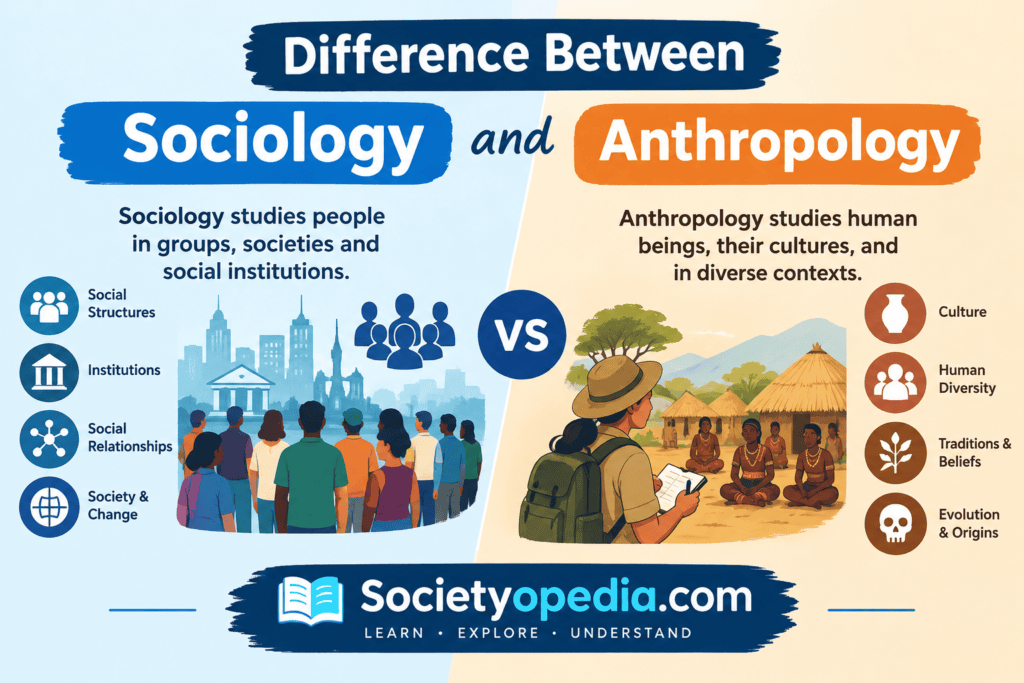
The main difference between Sociology and Anthropology is that Sociology mainly studies social relationships, institutions, and patterns of society, while Anthropology studies humans, cultures, and human development across different societies and historical periods. Both are social sciences that help us understand human behavior, culture, and social life.
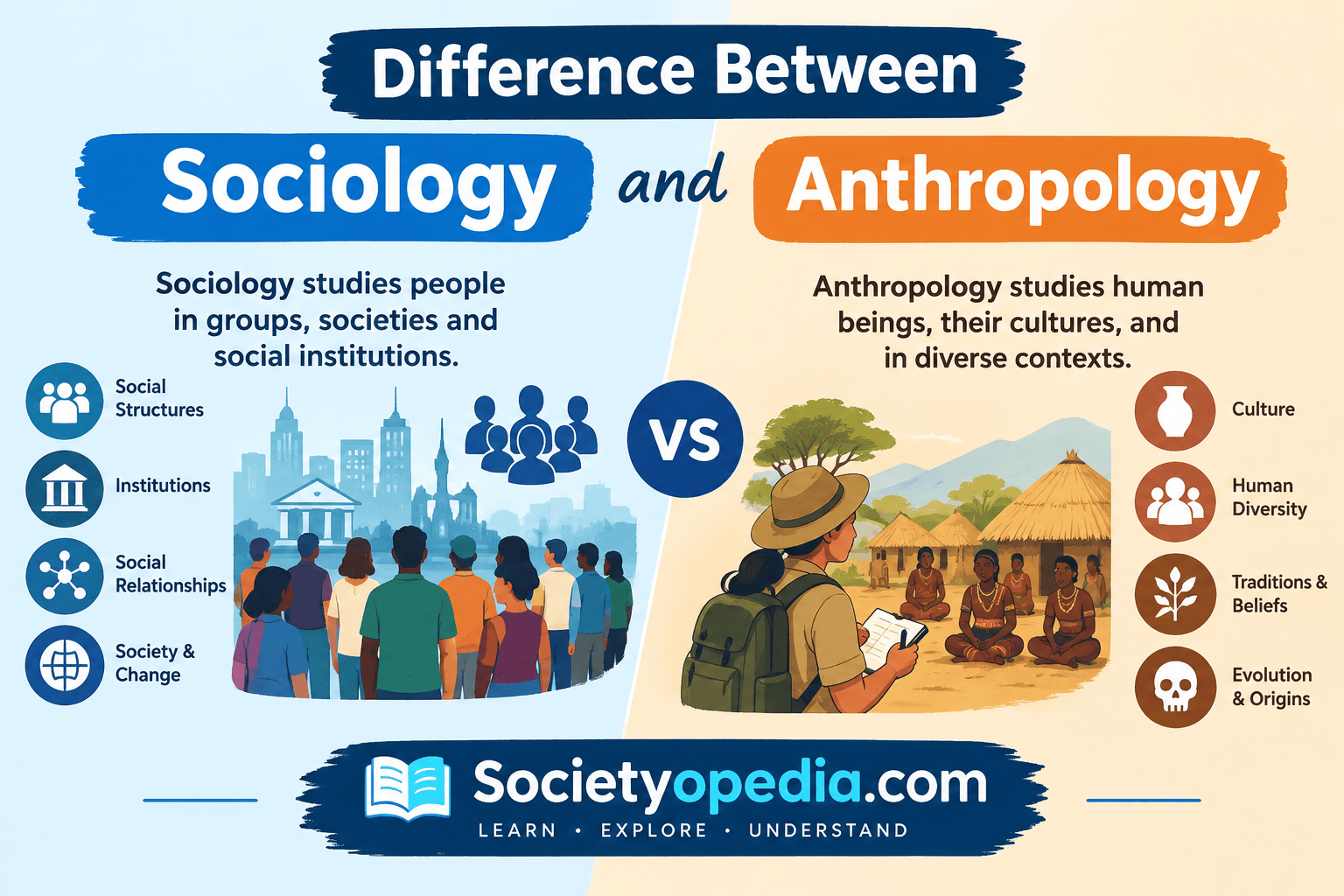
What Is Sociology?
Sociology is the scientific study of society, social relationships, groups, institutions, and patterns of human behavior. Sociologists examine how people interact and how factors such as social class, gender, education, religion, family, and power influence their lives.
Sociology often focuses on contemporary social issues and large-scale social patterns, although it also studies historical societies and small groups. Common research topics include poverty, unemployment, crime, social inequality, family relationships, and social change.
For example, a sociologist might study how social class affects students’ educational opportunities or how gender norms influence women’s employment.
What Is Anthropology?
Anthropology is the study of human beings, their cultures, societies, biological characteristics, and development across time and place. It seeks to understand human diversity and the similarities shared by different populations.
Anthropology includes several major branches, such as cultural anthropology, biological anthropology, linguistic anthropology, and archaeology. Depending on the branch, anthropologists may study cultural traditions, human evolution, language, ancient civilizations, or everyday life in different communities.
For example, an anthropologist might study marriage customs in different cultures or examine archaeological evidence to understand how ancient people lived.
Difference Between Sociology and Anthropology
| Basis | Sociology | Anthropology |
|---|---|---|
| Meaning | Study of society and social relationships | Study of humans, cultures, and human development |
| Main focus | Social institutions, groups, inequality, and social change | Human diversity, culture, evolution, and ways of life |
| Scope | Often emphasizes social structures and contemporary societies | Often takes a broad view across cultures and historical periods |
| Research methods | Surveys, interviews, statistical analysis, and observation | Ethnography, participant observation, interviews, archaeology, and biological methods |
| Common topics | Education, crime, class, gender, and social movements | Cultural practices, human evolution, language, and archaeology |
| Perspective | Examines social patterns and relationships | Examines human life through cultural, biological, linguistic, and historical perspectives |
| Example | Studying how poverty affects educational achievement | Studying how cultural traditions influence family life |
Examples of Sociology and Anthropology
A sociologist studying education may examine differences in school achievement between social classes. The research might use surveys and statistical data to identify patterns of inequality.
An anthropologist studying education may explore how learning takes place in different cultural settings. The researcher might observe classrooms, interview families, and examine local beliefs about teaching and learning.
Similarly, a sociologist may investigate how urbanization changes family relationships, while an anthropologist may examine how migration affects cultural identity and traditional practices.
These examples show that the two disciplines sometimes study similar subjects but may ask different questions or use different approaches.
Frequently Asked Questions
1. Are Sociology and Anthropology the same?
No. Sociology mainly focuses on social relationships, institutions, and social patterns, while Anthropology studies humans and human life through cultural, biological, linguistic, and historical perspectives.
2. Which is broader, Sociology or Anthropology?
Neither is universally broader. Anthropology explicitly combines several perspectives, including cultural, biological, linguistic, and archaeological approaches. Sociology also covers a wide range of social relationships, institutions, and social processes.
3. Do Sociology and Anthropology use the same research methods?
Yes, they sometimes use similar methods, including interviews, observation, and qualitative research. However, Sociology frequently uses surveys and statistical analysis, while Anthropology is especially associated with ethnography and participant observation. Methods vary by research topic.
4. Can Sociology and Anthropology study the same topic?
Yes. Both disciplines can study family, religion, gender, education, migration, and social inequality. They may approach these topics from different theoretical and methodological perspectives.
5. What is the importance of Sociology and Anthropology?
Both disciplines help us understand human behavior, cultural differences, social problems, and social change. Their findings can support research, public policy, education, and community development.
Conclusion
Sociology and Anthropology are closely related social sciences, but they have different emphases. Sociology mainly examines social relationships, institutions, and patterns of society, while Anthropology explores human beings, cultures, and human development from multiple perspectives. Both provide valuable knowledge about how people live and interact.
Societyopediaa provides simple explanations of Sociology, Psychology, Gender Studies, Research Methods, Anthropology, Education, and other social science concepts.