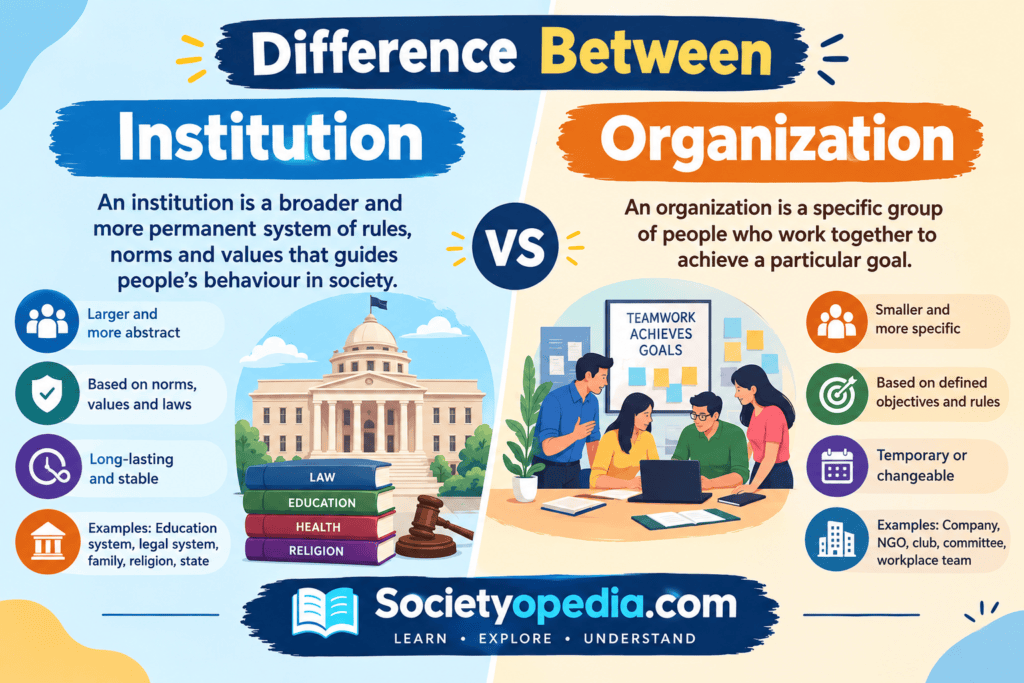
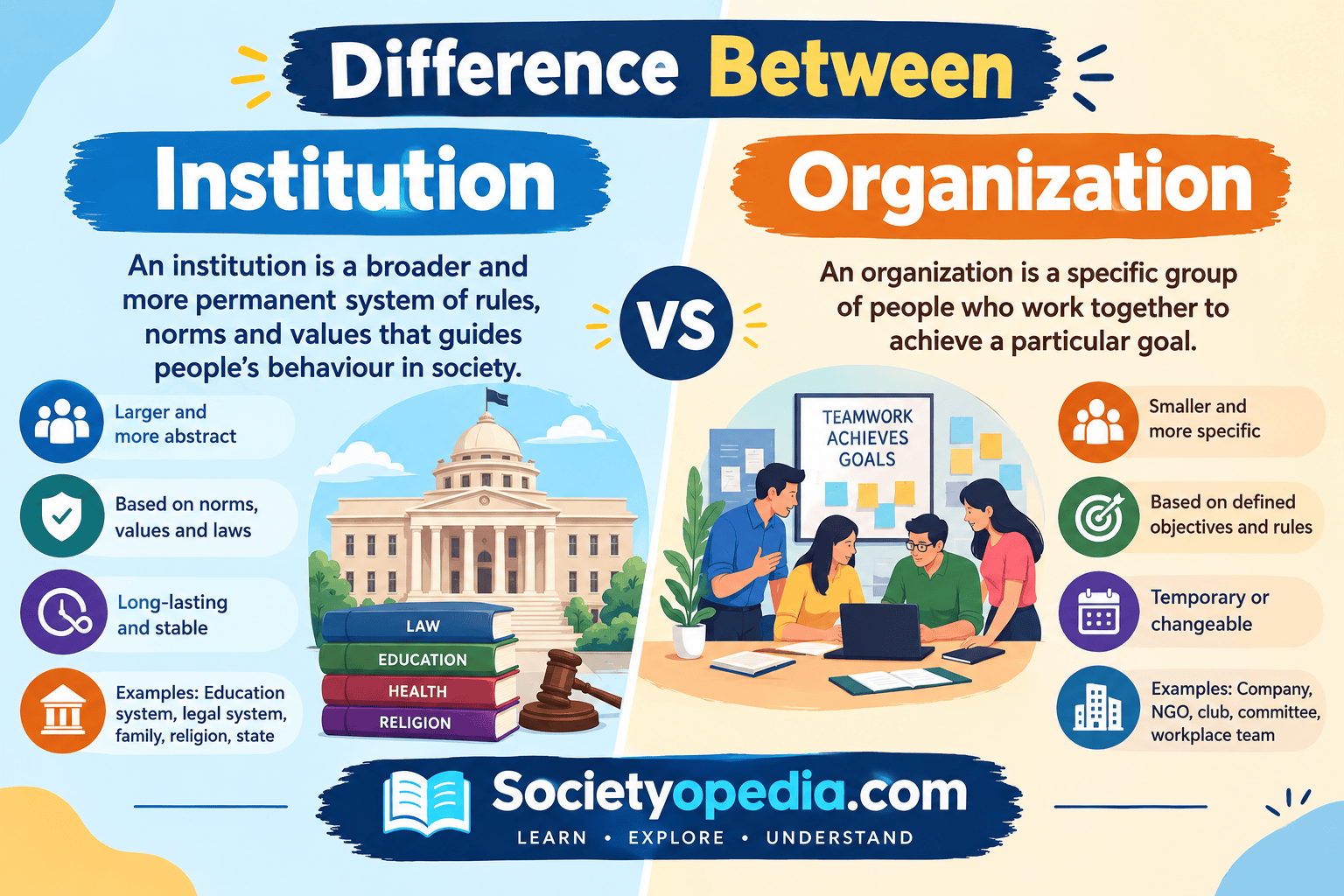
The main difference between an institution and an organization is that an institution is an established system of social rules, norms, and practices, while an organization is a structured group of people working together to achieve specific goals. Both are important in society, but they serve different purposes.
What Is an Institution?
An institution is an established system of rules, values, norms, and practices that guides human behavior and fulfills important social needs. Institutions help maintain social order and organize relationships among individuals and groups.
Institutions develop over time and influence how people behave in society. They may be formal or informal. Examples include family, education, religion, marriage, and the legal system. For example, the family institution establishes expectations about relationships, responsibilities, and care among family members.
In sociology, an institution does not always refer to a physical building. It mainly refers to the accepted rules and practices that guide social life.
What Is an Organization?
An organization is a structured group of people who work together to achieve common objectives. Organizations usually have defined roles, rules, responsibilities, and a management structure.
Organizations may be created to provide services, earn profit, promote social welfare, or achieve educational and political goals. Examples include schools, hospitals, universities, companies, and non-governmental organizations (NGOs).
For example, a university is an organization because it employs teachers and administrative staff to provide education and conduct research. It operates through departments, policies, and a management system.
Difference Between Institution and Organization
| Basis | Institution | Organization |
|---|---|---|
| Meaning | An established system of social rules and practices | A structured group of people |
| Main purpose | To fulfill social needs and regulate behavior | To achieve specific goals |
| Structure | May exist through informal or formal rules | Usually has a defined structure |
| Development | Often develops gradually over time | May be deliberately established |
| Membership | Does not always require formal membership | Usually has identifiable members |
| Examples | Family, marriage, religion, education | Schools, hospitals, companies, NGOs |
| Social role | Guides behavior and social relationships | Coordinates people and resources |
Examples of Institutions and Organizations
The education system is a social institution because it includes norms, values, and practices related to teaching and learning. A particular school or university is an organization because it has staff, students, administrators, and specific objectives.
Similarly, healthcare is an institution in the broader sense because it involves established practices and social expectations concerning health and medical care. A hospital is an organization that employs healthcare professionals and provides medical services.
Religion can be understood as a social institution because it includes beliefs, values, rituals, and norms. A particular religious association or organization has members, leadership, and a defined structure.
These examples show that institutions and organizations are connected, but they are not the same.
Frequently Asked Questions
1. Is a school an institution or an organization?
A school can be both. It is an organization because it has staff, students, and a management structure. It is also commonly called an educational institution because it provides education within an established social system.
2. Is family an institution or an organization?
Family is mainly considered a social institution in sociology because it involves established relationships, roles, norms, and responsibilities. Individual families can also be viewed as organized social groups.
3. What is the main difference between an institution and an organization?
An institution refers mainly to an established system of social rules and practices, whereas an organization refers to a structured group of people working toward particular goals.
4. Can an institution exist without an organization?
Yes. Social norms and practices can exist without a single formal organization. For example, marriage exists as a social institution across societies, even though different organizations may regulate or support it.
5. Are institutions and organizations related?
Yes. Organizations often operate within institutions. For example, universities operate within the broader educational institution and follow its established rules and expectations.
Conclusion
Institutions and organizations are both important for understanding social life. Institutions establish the rules, norms, and practices that guide behavior, while organizations bring people together to achieve specific goals. Understanding this difference helps students explain how society operates and how social systems are maintained.
Societypediaa.com provides simple explanations of Sociology, Psychology, Gender Studies, Research Methods, Anthropology, Education, and other social science concepts.