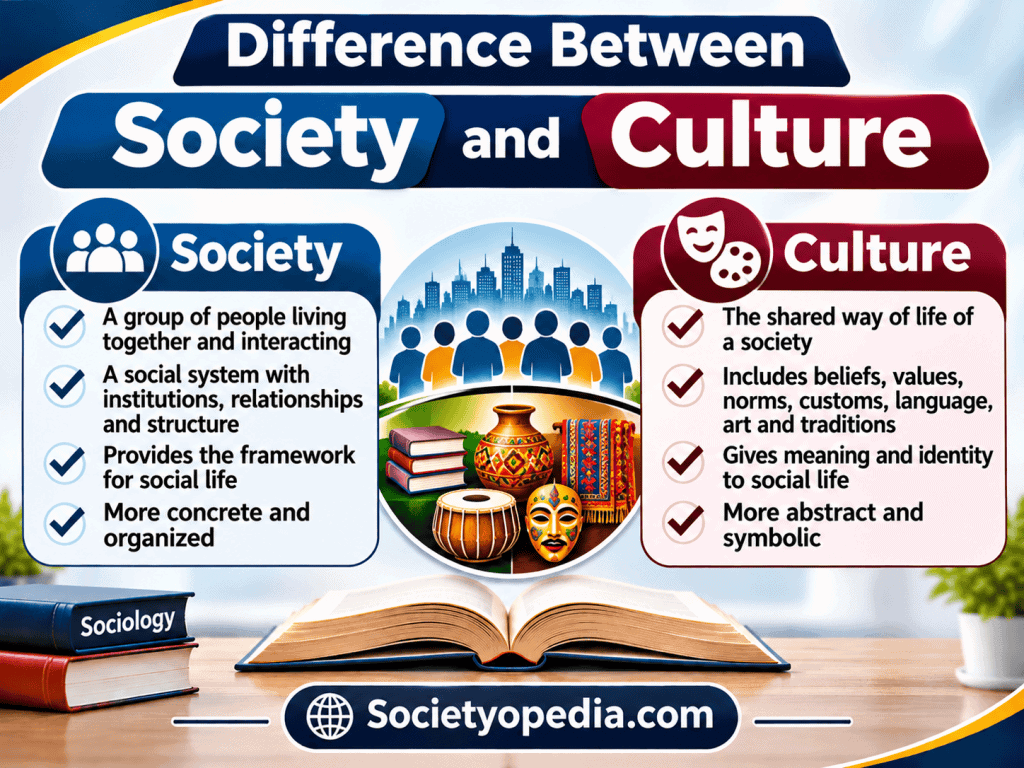
The main difference between society and culture is that society refers to a group of people connected through social relationships, while culture refers to their shared values, beliefs, customs, knowledge, and ways of life. Society describes how people are socially connected, whereas culture describes the meanings, practices, and ideas they share.
Both concepts are central to sociology because they help explain how people live together, develop social relationships, and pass ways of life from one generation to another.
What Is Society?
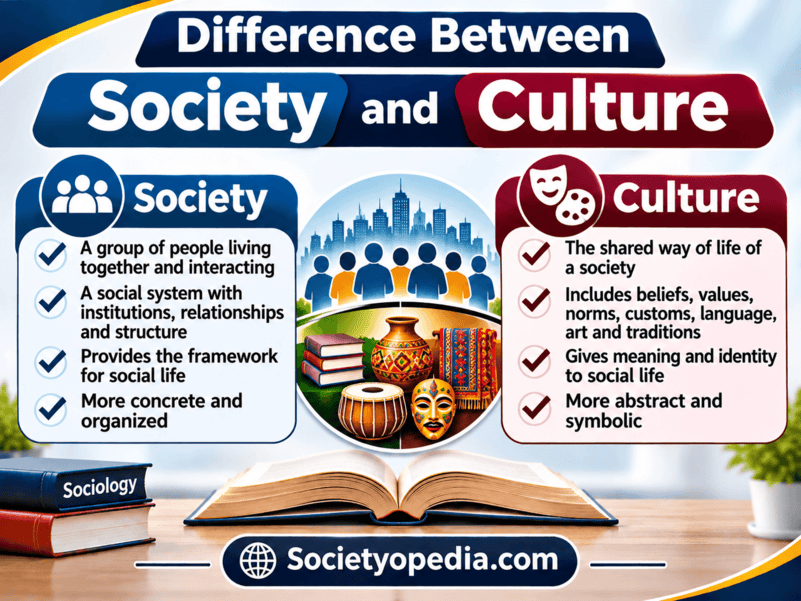
Society is a network of people who interact and maintain social relationships through groups, institutions, norms, and shared arrangements. It includes families, schools, workplaces, religious organizations, governments, and other social institutions.
For example, a national society includes people from different regions, occupations, and social classes. They interact through economic activities, education, laws, family relationships, and political systems.
Society provides the structure within which people organize their lives. Sociologists study society to understand social relationships, social institutions, inequality, cooperation, and social change.
What Is Culture?
Culture refers to the shared values, beliefs, customs, knowledge, language, symbols, and practices of a group. It influences how people understand the world, communicate, celebrate events, and decide what is acceptable in their social lives.
For example, greeting elders respectfully, celebrating cultural festivals, sharing traditional food, and speaking a common language can be parts of a group’s culture.
Culture includes both material and non-material elements. Material culture consists of physical objects, such as clothing, tools, buildings, and artwork. Non-material culture includes values, beliefs, language, customs, and social norms.
Culture is learned through socialization and passed from one generation to another. It can also change through education, migration, technology, and contact with other groups.
Difference Between Society and Culture
The difference between society and culture becomes clearer when we compare their main features.
| Basis | Society | Culture |
|---|---|---|
| Meaning | A network of people and social relationships | Shared ideas, values, beliefs, and practices |
| Main focus | Social relationships and organization | Meaning and ways of life |
| Main elements | Groups, institutions, roles, and relationships | Customs, language, beliefs, values, and symbols |
| Nature | Social structure and interaction | Shared meanings and practices |
| How it develops | Through human interaction and social organization | Through learning, sharing, and cultural transmission |
| Example | People connected through families, schools, and government | Their language, traditions, food, and beliefs |
Examples of Society and Culture
Consider a village where people interact through family ties, schools, local businesses, and community organizations. These relationships and institutions form part of village society.
The village’s traditional clothing, language, festivals, food, and customs are parts of its culture. Society describes the network of people and their relationships, while culture describes the shared ways of life within that network.
Another example is a university. Students, teachers, administrators, and staff form a social network with defined roles and relationships. This is part of the university’s social organization. Its academic values, traditions, language, and expectations about classroom behavior form part of its culture.
These examples show that society and culture are closely related. Society provides the setting for social life, while culture shapes how people understand and participate in that life.
Frequently Asked Questions
1. What is the main difference between society and culture?
Society refers to people and their social relationships, while culture refers to their shared values, beliefs, customs, and ways of life.
2. Can society exist without culture?
Human society and culture are closely connected. People living together develop shared meanings, practices, and rules, although cultural patterns can differ greatly between groups.
3. Can culture exist without society?
Culture develops and continues through social learning and interaction. Cultural practices may be preserved by small or dispersed groups, but culture is fundamentally connected to human social life.
4. How does culture influence society?
Culture shapes social behavior, values, relationships, and institutions. For example, cultural beliefs about family responsibilities can influence family structure and social roles.
5. Why are society and culture important in sociology?
They help sociologists understand social organization, human behavior, shared meanings, social identity, and cultural change.
Conclusion
Understanding the difference between society and culture helps explain two connected parts of human social life. Society refers to people and their relationships, while culture includes the shared ideas and practices that shape their lives. Societyopedia.com provides simple explanations of Sociology, Psychology, Gender Studies, Research Methods, Anthropology, Education, and other social science concepts.