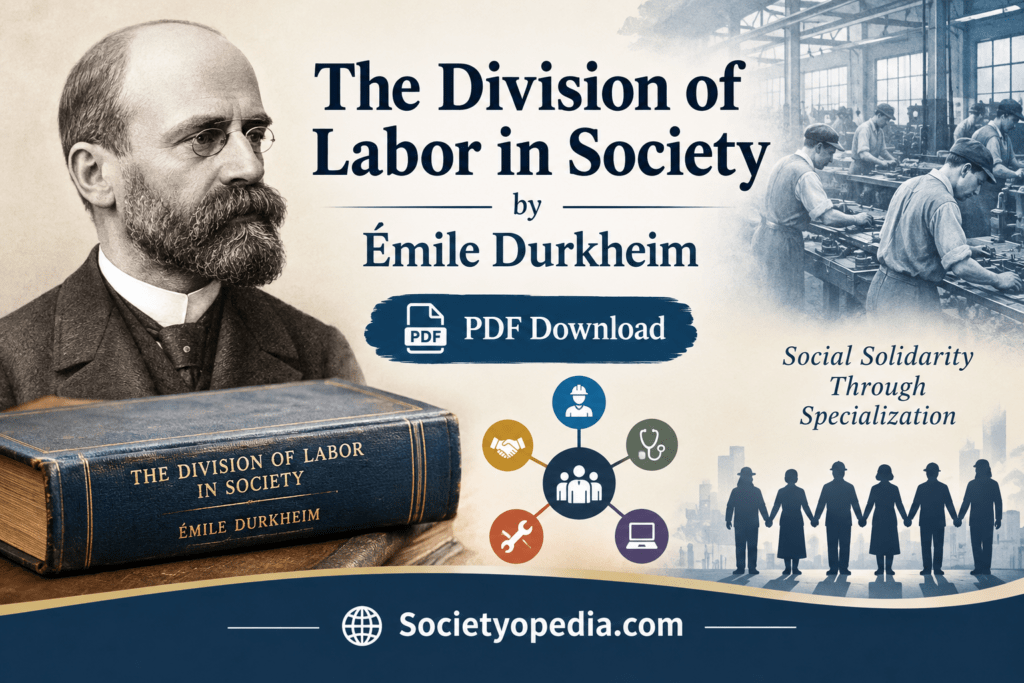
The Division of Labor in Society by Émile Durkheim is one of the foundational books of classical Sociology. Originally published in French in 1893 as De la division du travail social, it was Durkheim’s doctoral dissertation and became one of the most influential works in sociological theory. The book examines a fundamental question: what holds society together as societies become larger, more complex, and increasingly specialized?
Durkheim’s answer focuses on the changing nature of social solidarity. He distinguishes between mechanical solidarity, associated with societies characterized by strong similarities and shared beliefs, and organic solidarity, associated with more differentiated societies in which people depend on one another because of the division of labor.
The book remains highly relevant for Sociology students because it provides a foundation for understanding social integration, specialization, law, social cohesion, social change, and the relationship between individuals and society.

About the Author: Émile Durkheim
Émile Durkheim (1858–1917) was a French sociologist and one of the principal founders of modern Sociology. He played a major role in establishing Sociology as an academic discipline and emphasized the systematic study of social facts, institutions, norms, and forms of social organization.
Durkheim’s major works include The Division of Labor in Society, The Rules of Sociological Method, Suicide, and The Elementary Forms of Religious Life.
His sociological approach emphasized the importance of studying society as a reality with structures and forces that cannot be reduced simply to individual psychology. His work had a lasting influence on functionalism, Sociology of Religion, social integration, social theory, and the study of social institutions.
About The Division of Labor in Society by Émile Durkheim
The original French edition of The Division of Labor in Society was published in 1893. The work was later translated into English in several editions. The well-known English edition translated by George Simpson was published by Free Press, while a later translation by W. D. Halls, associated with Steven Lukes’s edition, was published by Macmillan in 1984. A 1997 Free Press edition is also widely catalogued and contains 352 pages. Different translations and editions therefore vary in pagination and presentation.
Durkheim’s central concern is social cohesion. He asks how societies maintain order when individuals increasingly perform different occupations and have different roles.
His answer is that the basis of solidarity changes as social differentiation increases. In simpler social arrangements, cohesion is largely based on similarity and shared beliefs. In complex societies, cohesion increasingly depends on interdependence created by specialization.
Overall Book Summary
At the heart of The Division of Labor in Society is Durkheim’s concept of social solidarity. Solidarity refers to the forces that connect people and maintain social cohesion.
Durkheim identifies two major forms: mechanical solidarity and organic solidarity.
Mechanical solidarity is associated with societies in which people have relatively similar experiences, occupations, beliefs, and ways of life. Social cohesion comes largely from what members have in common. Collective beliefs and values have a strong influence over individual behavior.
In such societies, Durkheim argues, the collective consciousness is particularly powerful. The collective consciousness refers to the shared beliefs, values, and moral attitudes that members of a society hold in common.
Durkheim connects mechanical solidarity with repressive law. When an individual violates strongly held collective norms, punishment can be severe because the offense is understood as an attack on the shared moral order.
The situation changes as societies become more differentiated.
Organic solidarity develops with increasing specialization and division of labor. Individuals perform different occupations and social roles, but these differences create mutual dependence. A doctor, teacher, farmer, engineer, driver, and shopkeeper perform different functions, yet each depends on the activities of others.
Durkheim compares this form of social organization to the different organs of a living organism. Each organ performs a specialized function, but the organism depends upon their coordinated functioning.
This is why Durkheim calls it organic solidarity.
The division of labor, therefore, is not simply an economic arrangement. It becomes a social and moral phenomenon. Specialization creates relationships of interdependence that can contribute to social cohesion.
Durkheim also examines the relationship between the division of labor and law. Organic solidarity is associated more closely with restitutive law, which seeks to restore relationships or establish appropriate arrangements rather than simply punish violations.
However, Durkheim does not argue that increasing specialization automatically produces a perfectly harmonious society. He discusses abnormal forms of the division of labor, including situations in which social regulation or coordination fails.
One important problem is the anomic division of labor, where insufficient regulation can produce uncertainty and weak social integration. Another concerns situations in which social roles are not properly coordinated.
The book The Division of Labor in Society by Émile Durkheim therefore presents social differentiation as a major transformation in the organization of society, but it also recognizes that specialization can create new social problems.
Another important issue is the relationship between individualism and social integration. Durkheim does not simply view individual freedom as opposed to society. In complex societies, individuals can become more differentiated and autonomous while remaining dependent upon others through social and occupational relationships.
This makes the book particularly important for understanding modern society. Durkheim’s argument suggests that increasing individual differences do not necessarily destroy social cohesion; under appropriate social and moral conditions, they can create new forms of interdependence.
Major Themes and Key Concepts
Division of Labor
The division of labor refers to the increasing specialization of social and occupational functions. For Durkheim, it is not merely an economic process but a transformation in social relationships.
Mechanical Solidarity
Mechanical solidarity is based largely on similarity, shared beliefs, common experiences, and strong collective consciousness.
Organic Solidarity
Organic solidarity develops through specialization and interdependence. People perform different functions but depend upon one another.
Collective Consciousness
The collective consciousness consists of shared beliefs, values, norms, and moral attitudes that contribute to social cohesion.
Repressive Law
Repressive law is associated with strong collective norms and sanctions against behavior considered to violate the shared moral order.
Restitutive Law
Restitutive law generally focuses on restoring relationships or regulating complex social and institutional arrangements.
Anomie
Anomie refers broadly to a condition of insufficient or weakened regulation. In the context of the division of labor, Durkheim identifies inadequate regulation as one potential abnormal form of social organization.
Social Interdependence
One of the most important insights of the book is that specialization can create interdependence. Individuals may become more different from one another while simultaneously becoming more dependent on one another.
Critical Review
One of the greatest strengths of The Division of Labor in Society is its explanation of social cohesion in complex societies. Durkheim provides a framework for understanding how societies can remain integrated even when people have increasingly specialized occupations, lifestyles, and identities.
The distinction between mechanical and organic solidarity remains particularly useful for Sociology students. It provides a straightforward way to examine differences between forms of social organization and the changing basis of social integration.
Another strength is Durkheim’s connection between social solidarity and law. His argument demonstrates that legal institutions can provide evidence about broader patterns of social organization.
The book also makes an important contribution by treating the division of labor as a social and moral issue rather than simply an economic one.
However, the book has limitations. Some of Durkheim’s historical and comparative claims have been questioned by later scholars. Robert K. Merton, for example, criticized aspects of Durkheim’s evolutionary argument and questioned the assumed correspondence between forms of solidarity and types of law.
The theory can also appear overly broad when applied to the enormous diversity of modern societies. Contemporary societies contain mechanical and organic forms of solidarity simultaneously, and social cohesion can be influenced by class, gender, ethnicity, politics, religion, nationalism, and many other factors.
Despite these limitations, the book remains a foundational contribution to sociological theory.
Who Should Read This Book?
This book is particularly useful for Sociology students, Social Science students, university teachers, researchers, and postgraduate students.
It is especially relevant to courses such as:
- Classical Sociological Theory
- Introduction to Sociology
- Social Theory
- Social Structure
- Social Change
- Sociology of Law
- Social Institutions
- Sociological Thought
Students preparing assignments, presentations, examinations, research proposals, and theses can also benefit from understanding Durkheim’s concepts of solidarity, collective consciousness, division of labor, law, and anomie.
Academic Importance
The academic importance of The Division of Labor in Society lies in its attempt to explain how social order and cohesion are maintained as societies become more complex.
Durkheim’s distinction between mechanical and organic solidarity became central to the development of functionalist Sociology and influenced later sociological research on social integration and institutions.
The book also demonstrates how sociologists can use legal systems and social institutions as evidence for understanding broader social structures.
For researchers, Durkheim’s work provides a theoretical starting point for studying occupational specialization, social integration, organizational relationships, social cohesion, professional groups, law, and institutional change.
It can also be compared with the work of Karl Marx and Max Weber. Marx emphasized class conflict and economic relations, while Weber examined social action, meaning, religion, and rationalization. Durkheim focused strongly on social integration, collective life, and the conditions of social order.
Final Verdict
The Division of Labor in Society by Émile Durkheim is an essential classic of sociological theory. Its central distinction between mechanical and organic solidarity provides one of the most influential explanations of how social cohesion changes as societies become increasingly differentiated.
The book can be challenging because of its historical arguments and theoretical language, and some aspects have been questioned by later scholars. Nevertheless, its concepts remain fundamental to the study of Sociology.
For students interested in social solidarity, social integration, social structure, division of labor, law, and classical sociological theory, this is a book worth reading.
PDF Download
Because the original work was published in 1893, readers can find digitized versions of the original French text and older editions through public digital-library collections. Open Library lists multiple editions of The Division of Labor in Society and provides reading and library-access information.
For readers specifically looking for a PDF, Open Library lists downloadable PDF options for some editions, although access can depend on the particular edition and borrowing restrictions.
PDF/library access: Open Library – The Division of Labor in Society
For the widely used modern English translation, readers should also check their university library, Google Books, Internet Archive, or the publisher/library catalogue because modern translations may remain subject to copyright restrictions. Google Books provides bibliographic information for the 1997 Free Press edition.
Academic article: Durkheim’s Division of Labor in Society – American Journal of Sociology