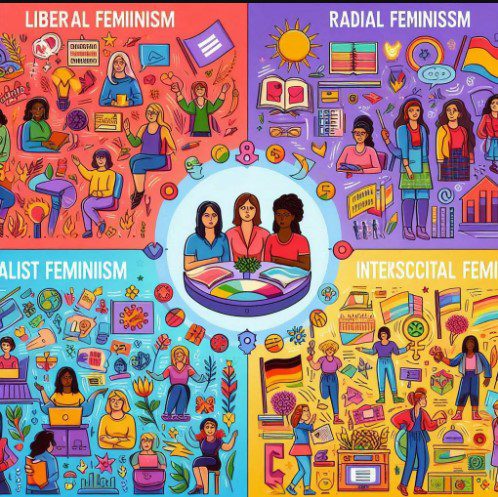
Many people ask about the Major Feminist Perspectives. Feminist theory is a diverse intellectual tradition that seeks to understand the causes, patterns, and consequences of gender inequality. Over the decades, feminists have analyzed how social institutions, cultural norms, political systems, and economic structures shape the lives of women and men. These analyses contributed to the development of several major feminist perspectives, each offering a unique explanation of oppression and a different strategy for achieving gender equality.
Understanding these perspectives is essential for students of Sociology, Gender Studies, Anthropology, Psychology, Political Science, and Social Work. The variety of feminist theories also reflects the diverse experiences of women across class, culture, ethnicity, religion, and geography. Below is a comprehensive guide to the major feminist perspectives, including classical, contemporary, and emerging approaches.
Liberal Feminism as a Major Feminist Perspective
Liberal Feminism is one of the earliest and most influential branches of feminist thought. It emerged during the Enlightenment period, when philosophers began discussing individual rights, freedom, and equality. Liberal feminists argue that women should have the same legal rights and opportunities as men because both are equally rational and capable.
Core Principles
Individual rights and freedoms: Women have the same intellectual ability and moral reasoning as men; therefore, gender-based discrimination is unjust and irrational.
Equal access to education and employment: Liberal feminists believe that many gender inequalities persist due to women’s limited educational opportunities and restricted economic participation.
Reforms within the existing system: They advocate for change within current political and legal frameworks, rather than calling for a revolutionary overthrow of society.
Goals and Strategies
Equal pay for equal work
Anti-discrimination legislation
Women’s right to vote, work, and own property
Political participation and representation
Legal reforms to eliminate gender-based injustices
Liberal feminism was instrumental in achieving many modern rights enjoyed by women, such as voting rights and workplace equality laws. However, it receives criticism for focusing primarily on middle-class women’s concerns and neglecting deeper structural inequalities.
Critiques
It does not fully address inequalities within the private sphere, such as domestic labour and caregiving.
Critics argue that legal changes alone cannot eliminate patriarchy.
It assumes that women can succeed if given equal opportunities, ignoring class and cultural barriers.
Radical Feminism as a Major Feminist Perspective
Radical Feminism emerged strongly during the second wave of feminism in the 1960s and 1970s. It is one of the most transformative feminist perspectives because it identifies patriarchy as the root cause of women’s oppression. Radical feminists argue that patriarchal power is deeply embedded in every aspect of society—from the family and religion to politics and economics.
Core Principles
Patriarchy as a global system: Male dominance is systemic, not accidental.
Control over women’s bodies: Issues like reproductive rights, sexuality, and violence are central concerns.
Gender roles are socially constructed: Femininity and masculinity are tools used by patriarchy to control women.
Focus Areas
Domestic violence
Sexual harassment
Rape culture
Pornography and objectification
Reproductive freedom
Compulsory heterosexuality
Radical feminists introduced the slogan “the personal is political”, emphasizing that women’s personal experiences—such as abuse or household responsibilities—are shaped by broader social structures.
Strategies for Change
Consciousness-raising groups
Women-centered spaces
Challenging traditional gender roles
Restructuring societal institutions to eliminate patriarchal norms
Critiques
Often viewed as too extreme or separatist
Accused of generalizing all men as oppressors
Less focused on intersectionality
However, radical feminism has made major contributions by bringing sexual violence, reproductive rights, and bodily autonomy into mainstream discourse.
Marxist Feminism
Marxist Feminism links women’s oppression directly to the capitalist economic system. Drawing on Karl Marx’s analysis of class inequality, Marxist feminists argue that capitalism depends heavily on women’s unpaid labour in the household and on underpaid labour in the workforce.
Core Principles
Capitalism and patriarchy operate together to exploit women.
Women’s unpaid domestic labour—childcare, cooking, cleaning—supports the capitalist economy.
Patriarchy ensures women remain economically dependent on men.
Women in the Household
Marxist feminists argue that the home is an economic unit, and women’s unpaid household labor contributes to the reproduction of the workforce. This labor is essential but undervalued and invisible in economic measurements.
Women in the Workforce
Women are often concentrated in low-paying jobs.
They face wage gaps and job discrimination.
They experience a “double burden” of paid and unpaid work.
Solutions
Abolition of the capitalist system
Redistribution of wealth
Collective ownership of resources
Social support systems, such as public childcare
Economic independence for women
Critiques
Overemphasizes class at the expense of gender
Does not fully address the cultural or psychological aspects of women’s oppression
Despite these critiques, Marxist feminism remains a powerful framework for analyzing gender and economic inequalities.
Socialist Feminism
Socialist Feminism emerged as a response to the limitations of both Marxist and radical feminism. Socialist feminists argue that neither patriarchy alone nor capitalism alone explains women’s oppression; instead, gender and class intersect in shaping women’s lived experiences.
Core Principles
Women’s oppression results from a combination of economic inequality, patriarchal norms, and cultural beliefs.
The family serves as a site where both capitalist and patriarchal power operate.
Care work and emotional labor must be recognized and valued.
Focus Areas
Unpaid domestic labor
Women’s reproductive work
Labor market discrimination
Gender roles in both public and private spheres
Solutions
Welfare policies supporting working women
Equal wages and workplace rights
State-subsidized childcare
Redistribution of domestic labor
Women’s empowerment through collective action
Critiques
Considered complicated because it draws on multiple theories
Lacks a single, unified framework
Despite this, socialist feminism offers a holistic approach that considers not only economic exploitation but also cultural and ideological dimensions of gender inequality.
Cultural Feminism
Cultural Feminism highlights the positive qualities associated with women, such as empathy, nurturance, cooperation, caregiving, and emotional intelligence. Unlike radical feminism—which sees gender differences as socially constructed—cultural feminism emphasizes that women’s traits are distinct and valuable.
Core Principles
Women have unique experiences and qualities that deserve recognition.
Society undervalues feminine characteristics due to patriarchy.
Promoting women-centred values can create a more peaceful and just world.
Examples of Feminine Values
Compassion
Cooperation
Emotional sensitivity
Community-building
Practices Inspired by Cultural Feminism
Women’s spirituality movements
Women-only cultural spaces
Emphasis on care ethics
Critiques
Sometimes viewed as essentialist for assuming all women share similar traits
Risks of reinforcing traditional gender stereotypes
May overlook differences among women across cultures and classes
Nevertheless, cultural feminism contributes significantly to discussions of care ethics, peace studies, and women’s cultural expressions.
Ecofeminism Explanation
Ecofeminism connects environmental degradation with the oppression of women. It argues that the same patriarchal structures that exploit women also exploit nature.
Core Principles
Patriarchy establishes a hierarchy that places men above both women and the environment.
Women’s traditional roles—such as farming, water collection, and nurturing—link them closely to natural systems.
Ecological destruction, climate change, and industrial pollution disproportionately affect women, especially in developing countries.
Types of Ecofeminism
Spiritual Ecofeminism: celebrates the sacred connection between women and nature, emphasising goddess traditions and earth-based spirituality.
Social/Materialist Ecofeminism: Focuses on political, economic, and ecological systems that marginalize women and harm the environment.
Contribution
Ecofeminism brings environmental justice, sustainability, and gender equality into the same conversation, making it highly relevant in today’s climate crisis.
Critiques
Can be too symbolic or spiritual for some scholars
Sometimes reinforces gender stereotypes, such as the idea that women are “naturally” closer to nature
Intersectional Feminism
Intersectionality, introduced by Kimberlé Crenshaw in 1989, is now one of the most important feminist frameworks. It argues that gender cannot be analyzed in isolation; instead, it intersects with race, class, ethnicity, religion, nationality, disability, and sexuality.
Core Principles
Women experience oppression in different ways depending on their identities.
A single feminist narrative cannot represent all women.
Social categories like race, caste, class, and religion interact with gender.
Examples
A wealthy woman and a poor woman face different challenges.
A Muslim woman may experience Islamophobia along with sexism.
Black women experience racism and sexism simultaneously, not separately.
Importance in Contemporary Debates
Intersectional feminism forms the basis of many modern social justice movements, including anti-racism campaigns, disability rights activism, and LGBTQ+ advocacy.
Critiques
Some argue it is too broad and difficult to apply in policy-making.
Critics suggest it shifts focus away from collective feminist goals.
Despite criticisms, intersectionality is essential for understanding real-life complexities and diverse experiences of women.
Postmodern Feminism
Postmodern Feminism challenges fixed categories of gender and identity. Influenced by postmodern thinkers like Judith Butler, it argues that gender is not natural but rather a discursively constructed concept shaped by language, culture, and power.
Core Principles
There is no universal definition of “woman.”
Gender identities are fluid and socially constructed.
Power operates through language, culture, and social norms.
Binary oppositions (male/female) are artificial constructions.
Focus Areas
Media representations
Identity politics
Deconstruction of traditional gender roles
Critique of essentialism
Critiques
Seen as too abstract and theoretical
Offers fewer practical strategies for addressing real-world inequalities
Sometimes criticized for being overly academic
However, postmodern feminism has revolutionized gender theory by challenging rigid ideas about identity and opening space for LGBTQ+ perspectives.
Best Books on Feminist Theory and Major Feminist Perspectives
Here is a curated list of essential books for students and researchers of feminism:
Foundational Feminist Texts
The Second Sex – Simone de Beauvoir
A Vindication of the Rights of Woman – Mary Wollstonecraft
The Feminine Mystique – Betty Friedan
Radical & Intersectional Feminism
Gender Trouble – Judith Butler
Ain’t I a Woman? – bell hooks
Women, Race & Class – Angela Davis
Marxist & Socialist Feminism
The Origin of the Family, Private Property and the State – Friedrich Engels
Capitalist Patriarchy and the Case for Socialist Feminism – Heidi Hartmann
Ecofeminism
Ecofeminism – Maria Mies & Vandana Shiva
Contemporary Accessible Works
Feminism Is for Everybody – bell hooks
We Should All Be Feminists – Chimamanda Ngozi Adichie
These texts collectively offer historical, theoretical, political, and contemporary perspectives on feminism.
Conclusion
Feminist theory is not a single idea but a diverse set of perspectives known as the major Feminist Perspectives that analyze gender inequality from multiple angles. Liberal, Radical, Marxist, Socialist, Cultural, Ecofeminist, Intersectional, and Postmodern Feminism each contribute powerful insights into how patriarchal structures operate and how gender justice can be achieved.
Together, these perspectives help us understand how economics, culture, identity, sexuality, power, and social norms shape women’s and men’s experiences differently. In today’s world—shaped by globalization, digital media, climate change, and shifting identities—feminist perspectives remain essential for building a more just and equitable society. Stay tuned with Societypedia for more concepts.

